
Dedicated courier vs parcel delivery: which should you use?
Use a parcel network for routine, well-packed parcels that can arrive tomorrow. Use a dedicated courier when the goods must arrive today, at a set time, are too big or heavy for network limits, or cannot risk being sorted.
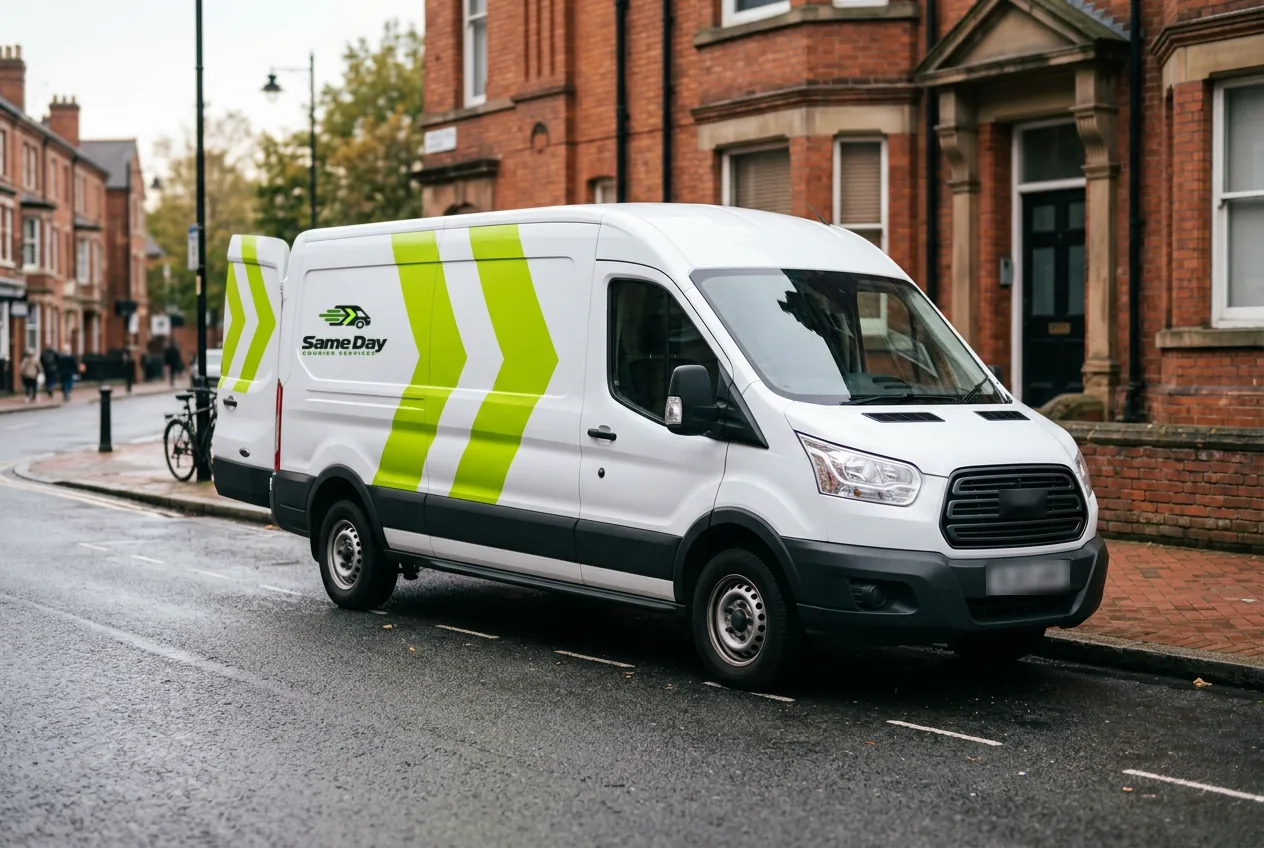
Dedicated or network: the short answer
The choice between a dedicated courier vs parcel delivery comes down to handling, speed and cost. A parcel network moves thousands of parcels through shared hubs, so each parcel is cheap to send but is handled several times and usually arrives on a later day. A dedicated courier puts one vehicle and driver on your consignment and drives it straight to the recipient, so it arrives the same day and is barely handled, but you pay for the whole vehicle.
Neither is better in general. The right choice depends on how urgent the goods are, how big or fragile they are, and how many separate deliveries you are making.
How each service moves your goods
A parcel network moves your goods through local depots and a sorting hub, handling each parcel several times and usually delivering on a later day. A dedicated courier collects your consignment in one vehicle and drives it directly to the delivery address, with no depots, no other customers' goods and only two lifts: on and off.
A parcel network works on a hub-and-spoke model. A driver collects your parcel on a round, often in the afternoon, along with many others. It goes to a local depot, is loaded onto a lorry with thousands of other parcels and trunked overnight to a hub, where it is sorted by conveyor and scanner, then sent to the depot nearest the recipient. Next morning it goes out on a delivery round with perhaps 100 or more other stops. Royal Mail, Parcelforce, DPD, Evri, Yodel and UPS all work broadly this way.
A dedicated courier works point to point. One vehicle collects your consignment, the driver secures it in the van, and the van goes directly to the delivery address with no depots and no other customers' goods. Our dedicated courier service works like this on every job, unless you ask for several drops on one route.
The difference in handling is significant. A parcel in a network may be picked up, scanned, dropped onto a belt, diverted down a chute and stacked in a cage several times before it reaches the recipient.
Side-by-side comparison
| Item | Dedicated courier | Parcel network |
|---|---|---|
| Route | Direct from collection to delivery | Via one or more depots and sorting hubs |
| Typical speed | Same day; arrival time depends on distance and traffic | Next day or later for standard services; timed options cost more |
| Collection time | When you need it, including evenings and weekends | On the driver's round, usually within a set window |
| Delivery time | Planned around your deadline | Within the network's delivery window for that service |
| Handling | Loaded once, unloaded once, by the same driver | Multiple touches, conveyors, chutes and cages |
| Size and weight | Limited by the van: from a small van up to a Luton with tail lift | Strict per-parcel limits; Parcelforce express services, for example, cap parcels at 30 kg and 1.5 m long |
| Pricing basis | The vehicle, distance and timing | Per parcel, by weight or volumetric weight, whichever is greater |
| Cost for one item | Higher, because you pay for the whole vehicle and driver | Much lower |
| Cost at volume | Rises with every extra vehicle or drop | Low per parcel, with discounts for account volumes |
| Cover | Goods in transit cover as standard; limits and exclusions in the courier's terms | Usually modest standard compensation, with extra cover per parcel |
| Tracking | Live updates throughout the job | Scan events at each depot, plus a delivery window on the day |
| Proof of delivery | Recipient's name, time and signature, often with a photo | Varies by service: signature, photo or a safe-place record |
| Changes after collection | The driver can be redirected or retimed | Very limited once the parcel is in the network |
Network size and weight limits vary by carrier and service. The Parcelforce express service limits (30 kg, 1.5 m long and 3 m length plus girth combined, with standard compensation up to £150) are a useful benchmark for what a typical network will accept.
Why one costs so much more than the other
A parcel network spreads the cost of every lorry, depot and delivery van over thousands of parcels, so your share is small. A dedicated courier puts one van and one driver on your job for the whole run, and the van often comes back empty. That is why sending one box 100 miles might cost a few pounds by network and well over £100 by dedicated van.
The comparison changes with bulk. Networks charge by volumetric weight, often calculated as length × width × height in centimetres divided by 5,000. A light but bulky carton of 100 × 60 × 60 cm is charged as 72 kg, which pushes it beyond many networks' weight limits altogether. A dedicated van prices that carton by the space it takes in the vehicle, which is a far more natural fit for awkward, light goods. Our guide to how much a same-day courier costs explains the pricing factors in more detail.
When a parcel network is the right choice
A parcel network is the right choice when the goods can arrive tomorrow or later without any real consequence, and each parcel is within the network's size and weight limits and packed to survive conveyors and drops. It suits high volumes of small parcels going to many addresses, such as online orders.
It also makes sense when:
- The value of each parcel is within the standard compensation, or you buy extra cover.
- Nobody needs to be told exactly when the parcel will arrive.
A home-ware shop sending 60 orders a day, each under 5 kg and boxed to a standard, should be using a parcel network. Paying for a dedicated van for each order would make no commercial sense.
When a dedicated courier is the right choice
A dedicated courier is the right choice when the goods must arrive today or at a specific time, and a missed deadline would cost more than the delivery itself. It is also the better option for items over network limits, fragile or high-value goods, and consignments that need temperature control or a signed proof of delivery.
Typical signs include:
- A deadline with real consequences: a stopped production line, a court filing, a tender submission, an event that opens at 9.00 am.
- Goods that are long, heavy, bulky or on a pallet.
- Goods that must travel upright, where repeated handling is a real risk.
- A need to know where the goods are throughout the job.
A 22 kg replacement controller board for a stopped CNC machine in Sheffield is a dedicated job: the cost of the line standing idle dwarfs the price of the van. So is a 1.9 metre architectural model going to a planning presentation in Cambridge, which no network would accept and which should never go down a chute. Long or heavy items like that sit with our large item courier service.
The options in between
Many businesses do not need to choose one or the other for everything. A few services sit between the two extremes.
- Same-day parcel delivery in a small van. For a single box or a handful of parcels that must arrive today, our same-day parcel service sends the smallest suitable vehicle, which keeps cost down while keeping the direct route.
- Dedicated next-day or overnight. If the deadline is first thing tomorrow, a dedicated van can collect this evening and deliver early, often at a lower price than a daytime urgent job. See next-day courier.
- Multi-drop. One dedicated van delivering a planned route of stops, with a signature at each one. This suits regular store replenishment or same-day orders across one city. See multi-drop courier.
Retailers often run a mix: a network for everyday orders and a dedicated courier for urgent replacements, large items and store deliveries, an approach covered on our retail and e-commerce courier page.
A quick way to decide
Ask these questions about the consignment
- What happens if it arrives tomorrow afternoon rather than today?
- Is any single piece over 30 kg or longer than about 1.5 metres?
- Would it survive being dropped from waist height onto a conveyor?
- Is it worth more than the network's standard compensation?
- Does someone need to be told exactly when it will arrive?
- Is it one consignment to one address, or many parcels to many addresses?
If the answers point towards tomorrow being fine, small parcels and robust packing, a network is the sensible option. If the deadline is real, the goods are big or delicate, or a signature from a named person matters, use a dedicated vehicle. Either way, good packing helps, and our guide to packaging fragile items applies to both.
FAQ
Common questions
Is a dedicated courier always faster than a parcel network?
For a single urgent consignment, almost always, because the van goes straight from collection to delivery. Over short distances the gap is hours; over long distances a same-day dedicated van can still beat a next-day network. Where a network wins is volume: it can deliver hundreds of parcels to hundreds of addresses tomorrow, which no single van can match.
Can a parcel network deliver the same day?
Some networks sell same-day products in certain cities, but they usually have early booking cut-offs, tight size and weight limits and restricted postcodes. Standard network services collect today and deliver on a later day, because the parcel has to pass through at least one sorting hub. For anything outside those limits, a dedicated vehicle is the usual route.
Why does a parcel network charge me for weight my parcel does not have?
Networks price by whichever is greater: actual weight or volumetric weight. Volumetric weight is commonly length × width × height in centimetres divided by 5,000, so a light but bulky box can be charged as if it were heavy. A dedicated courier prices by the vehicle needed instead, so bulky, light goods are often better value that way.
Are my goods covered either way?
Both types of service usually include some cover, but the level differs. Network parcel services commonly include modest standard compensation, with extra cover sold per parcel. Our jobs carry goods in transit cover as standard; limits and exclusions are in our terms, so tell us the value when booking and we will confirm cover or arrange additional cover for high-value goods.