
Courier van sizes: which vehicle do you need?
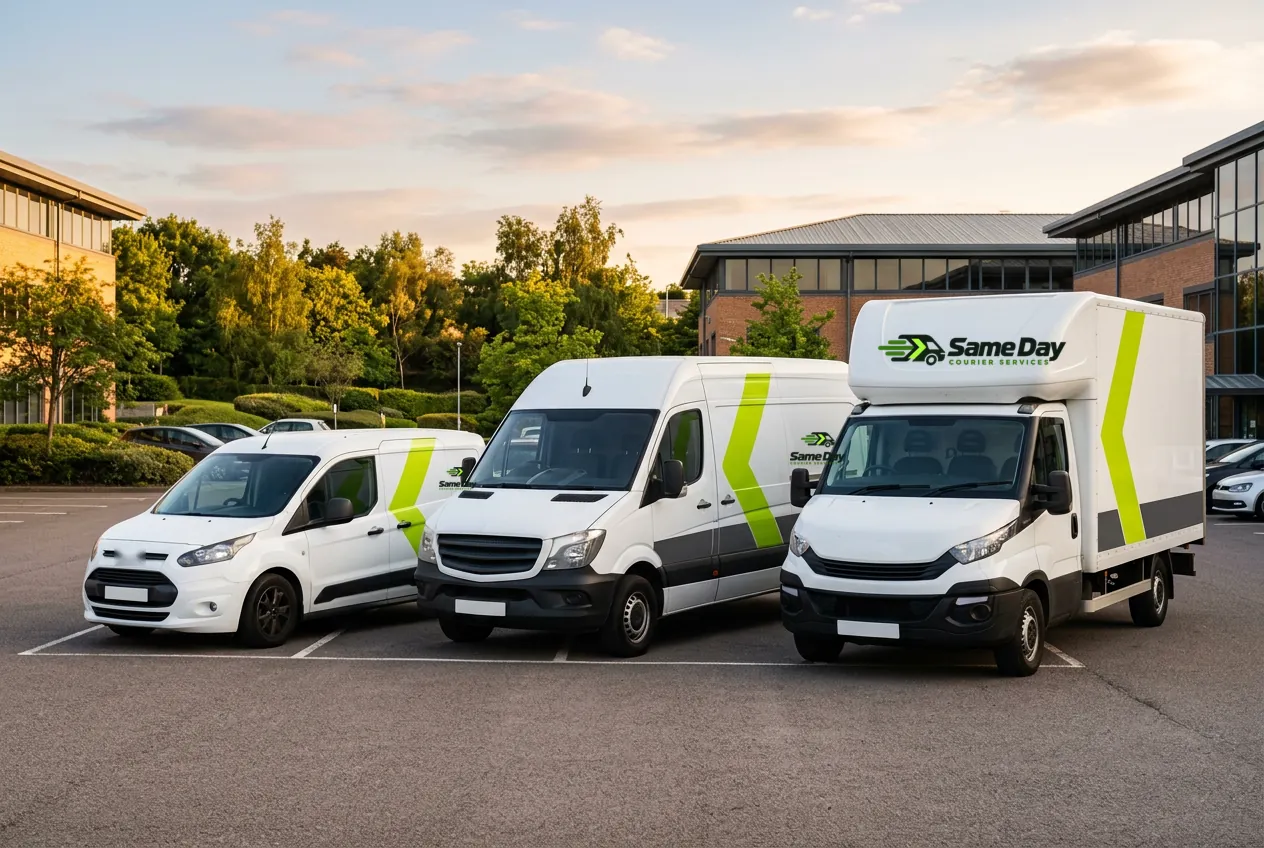
Most same-day loads fit one of six vans, from a small van for boxes to a Luton with a tail lift for furniture and heavy kit. Compare typical load space and payload below, then measure your load to choose.
- Typical load space and payload
- Pallets per vehicle at a glance
- Tail lift and refrigerated options
Start with the largest item, not the total volume
Choosing a courier van comes down to three questions: will the longest item fit on the floor, will everything fit through the doors and under the roof, and will the total weight stay within the van's payload. Get one wrong and you lose time arranging a bigger vehicle on the day.
Courier van sizes compared
Read every figure in this table as typical for that class of van. The make, the model and the body fitted all shift the numbers slightly, which is why we confirm the specification of the actual vehicle at booking.
| Vehicle | Typical load space (L × W × H) | Typical payload | UK pallets (1200 × 1000 mm) | Good for |
|---|---|---|---|---|
| Small van | about 1.8 m × 1.2 m × 1.1 m | up to around 500 kg | 1 | documents, boxes, small parcels, one pallet |
| SWB van | about 2.4 m × 1.6 m × 1.3 m | around 800–1,000 kg | 2 | several boxes, machinery parts, two pallets |
| MWB van | about 2.9 m × 1.7 m × 1.6 m | around 1,000–1,200 kg | 2–3 | bulkier loads, small furniture |
| LWB van | about 3.4 m × 1.7 m × 1.8 m | around 1,100–1,300 kg | 3 | long items, three pallets, exhibition kit |
| Luton van with tail lift | about 4.0 m × 2.0 m × 2.0 m | around 1,000 kg | up to 5 (weight usually limits first) | furniture, bulky and heavy items, cages; tail lift typically rated to about 500 kg |
| Refrigerated van | depends on conversion; insulated load area | depends on vehicle | depends | chilled food, medical and pharmaceutical goods |
What each van typically carries
A small van typically carries documents, boxes or one pallet; SWB and MWB vans take two to three pallets or bulkier loads; an LWB van takes long items and three pallets; and the Luton with tail lift takes furniture and heavy goods. Refrigerated vans carry chilled consignments. Exact capacity depends on the vehicle model, and we confirm it at booking.
Small van
The small van covers most urgent jobs that are not large: a box of spare parts, a laptop and docking station, a run of printed brochures, or a single pallet of stock up to the van's payload. It is the cheapest van to run and the easiest to park, which makes it the usual choice for same-day parcels and documents.
SWB van
A short-wheelbase van suits a dozen or more archive boxes, a pair of pallets, or engineering parts such as a gearbox or a pump. The extra height means boxes can be stacked.
MWB van
The medium-wheelbase van is the step up for loads that are bulky rather than heavy: a desk and chair, retail display units, a run of flat-packed shelving or a shop refit order. It can take two or three pallets depending on how they are arranged.
LWB van
With about 3.4 metres of floor and a tall roof, the long-wheelbase van handles lengths of pipe or timber, rolled banners, three pallets and most of the stand and AV kit for a small exhibition booth.
Luton van with tail lift
The Luton's square box body gives the most usable space we offer: roughly 4 metres long and 2 metres wide and high. It is the van for sofas, wardrobes, roll cages, stacked furniture and large items too heavy to lift into the van by hand. The box body is heavy, so payload is around 1,000 kg, often less than an LWB.
Refrigerated van
Our refrigerated vans have an insulated load area and a refrigeration unit, used for chilled food and medical and pharmaceutical deliveries. How much room you get depends on how the van has been converted. You tell us the temperature the goods need and we agree it at the booking stage; as a guide, many medicines are kept at 2–8 °C and a lot of chilled food at 0–5 °C.
How to measure your load
Measure each item in metres: length, width and height, at its widest points, including handles, feet and any packaging. Then add the following to your booking:
- The longest single item, which decides the minimum floor length.
- The tallest item, and whether it can lie flat or must stay upright.
- How many pieces there are and roughly how they would stack.
- The total weight, from delivery notes, product data or a scale.
A van's load space is not a perfect box. Wheel arches take width at floor level, and door openings are smaller than the load area. A 1.25-metre-wide crate may clear the floor between the arches in one van and not in another, so send the dimensions and we will compare them with the van we intend to use.
Weight versus volume
A van full of empty display stands runs out of space long before it gets heavy. A van carrying boxes of printed paper, tiles or metal castings can hit its payload with half the floor still empty.
Payload is what the van can legally carry once its own weight, the driver and fuel are counted. A "3.5-tonne van" is rated at 3.5 tonnes gross vehicle weight, so the goods allowance is far lower, typically 800–1,300 kg for a panel van and around 1,000 kg for a Luton. A driver will refuse a load that would overload the van.
Tail lift limits
A tail lift makes heavy items far easier to load at sites without a loading bay, but it has a rated capacity, typically about 500 kg on a Luton. That rating includes the pallet and any pallet truck. A 700 kg pallet cannot go up on a 500 kg tail lift, even if the van itself has payload to spare.
The tail lift also needs firm, level ground and room to lower the platform. On a sloping street or gravel drive a pallet truck will not roll safely, so tell us about the ground at both ends.
When to choose a bigger van
Choose a bigger van when your load is close to the smaller van's limits or cannot be packed tightly. A van that turns up too small means a second vehicle or a delay, so if you are between two sizes, the larger one is usually the safer choice. Go up a size when:
- Your measurements are within about 10 centimetres of the van's limits.
- Items cannot be stacked, laid down or turned on their side.
- The load is fragile and needs space around it rather than packed tight.
- You are unsure of the exact quantity and may add pieces on the day.
- The load is heavy and needs a tail lift rather than hand loading.
The reverse applies too: for a small, light load, a smaller van is cheaper.
Pallets per vehicle
Standard UK pallets are 1200 × 1000 mm, Euro pallets 1200 × 800 mm. Counting UK pallets, the small van holds one and the SWB two. The MWB manages two or three depending on layout, the LWB three, and the Luton has floor for five, although its payload normally runs out first. For floor plans and weight sums, read our article on pallet capacity by van, and the pallet delivery page explains how same-day pallet jobs are booked.
FAQ
Common questions
Which van do I need for a two-seater sofa?
A typical two-seater sofa is around 1.5 to 1.8 metres long and nearly a metre deep, so it fits an LWB van, which has about 3.4 metres of floor. If the sofa comes with an armchair, a table or boxes, a Luton gives more height and width.
Can I book a bigger van than I think I need?
Yes, and it is sometimes the sensible choice when your measurements are close to a vehicle's limit or the load is awkwardly shaped. A larger van costs more, so we will tell you the price difference at booking. Paying a little more for the next size up is cheaper than a van arriving that cannot take everything.
Why is the payload of a 3.5-tonne van not 3.5 tonnes?
The 3.5 tonnes is the gross vehicle weight: the maximum the van can weigh fully loaded. Payload is what is left after the weight of the van itself, the driver and the fuel. For most panel vans that leaves somewhere between 800 and 1,300 kg, and a Luton's heavy box body leaves it nearer 1,000 kg despite its size.
Do you have vans bigger than a Luton?
No. The tail-lift Luton is the top of our range, and 7.5-tonne and larger lorries are not part of the fleet. Loads that are too heavy or too big for a Luton need a lorry operator. If a load is borderline, send us the measurements and weights and we will tell you honestly whether it can go in one of our vans.
Will the driver bring a pallet truck?
Not automatically. If either address has no forklift, say so when you book and we will check whether the van can carry one. A tail-lift Luton paired with a pallet truck is the usual way to handle a pallet at a site with no loading bay, provided the ground is firm and level and the pallet is within the tail lift's rating.
Can a refrigerated van carry ambient goods as well?
Refrigerated vans are insulated, so they can carry ambient goods, but mixing chilled and ambient items in one load area needs care. The range for your load is set with you when you book; chilled work commonly sits between 2 and 8 °C. See our refrigerated courier page for how chilled jobs are planned.
Last updated