
Dedicated courier service, direct door to door
A dedicated courier means the van is yours for the job. One driver collects your goods, drives them directly to the delivery address and hands them over, with no depot, no other customers' parcels and no transfers on the way.
- Exclusive use of the vehicle
- One driver, one chain of custody
- Wait and return jobs handled
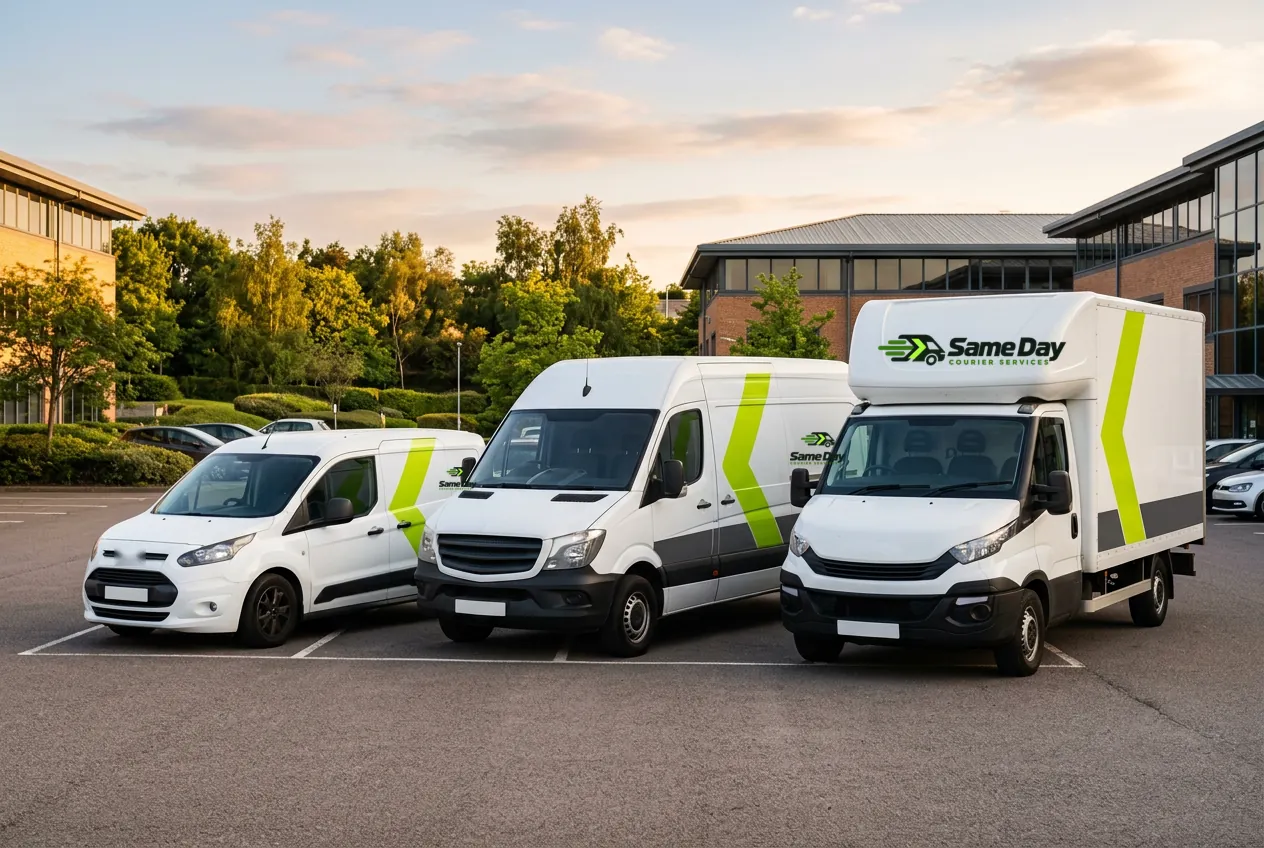
What "dedicated" means on the road
The word gets used loosely, so here is what it means on our jobs. We assign one vehicle and one driver to your consignment. Your driver loads at your door and heads for the delivery address without a detour. Nobody else touches the goods between the moment they go in the van and the moment a named person signs for them.
That rules out a lot of what happens on a parcel network:
- No sorting. Your goods never go on a conveyor or into a cage with other people's parcels.
- No transfers. There's no trunking lorry, no hub, no second van for the final mile.
- No co-loading. The van isn't carrying anyone else's consignment, so no one else's deliveries come first.
- One chain of custody. The person who signed for your goods at collection is the person who hands them over at delivery.
Each of those points is a place where a networked parcel can be delayed, misrouted or damaged. Remove them and the job becomes far more predictable. Along the way you see progress updates, and at the end you receive a proof of delivery showing who signed, at what time, with a photo where it helps.
When it's worth paying for, and when it isn't
A dedicated van costs more than putting a box on a parcel network, because you're paying for a vehicle and driver for the length of the trip. Whether that's worth it depends on what happens if the item is late, damaged or lost.
| Your situation | Parcel network | Dedicated courier |
|---|---|---|
| Boxed item, can arrive in two or three days | Usually the sensible choice | More than you need |
| Needed today or by a set time | Not possible on most services | Built for this |
| Fragile, unboxed or awkward to pack | Risky with repeated handling | Loaded once, secured by the driver |
| Over network size or weight limits | Refused or heavily surcharged | Accepted, provided the van can take it |
| High value or confidential | Several hands, several scans | One driver from start to finish |
| Needs a signature or item back | Rarely available | Wait and return is routine |
A good test is to ask what a failed delivery would cost you. If the answer is a delayed customer order, a network is probably fine. If it's a stalled installation, a missed completion or a crew standing idle, a direct courier is cheap insurance against that. There is a longer comparison in our article weighing a direct van against a parcel network.
Wait and return jobs
Some deliveries aren't finished when the item is handed over. On a wait and return job, the driver delivers, waits while something is done at the address, then brings an item or document back to you or on to a third address.
Sign-and-return contracts. A contract, lease or set of deeds goes out for a wet-ink signature and must come back the same day. The driver hands the papers to the named signatory, waits, and returns them sealed. Law firms and finance teams use this when an electronic signature won't do; see our legal and financial courier page for how we handle that work.
Swap-outs. A faulty unit goes back as the replacement arrives. Think of a point-of-sale terminal, a network switch, a laptop for a member of staff, or a hire tool that has stopped working on site. The driver brings the replacement, waits while it's tested, and takes the faulty one away. Our IT equipment courier service covers the packing side of this.
Loan equipment. Demonstration kit, display stock, instruments or tools lent for a day often travel out in the morning and back the same evening. That might be one driver waiting all day, or two separate bookings. We'll suggest whichever is better value.
Make wait and return jobs run to time
Give us an idea of how long the driver may be kept waiting, the name to ask for at reception, and what is coming back, including its size if it differs from the outbound item. A signatory who's in a meeting when the driver arrives is the most common cause of a long wait, so a quick call ahead to the address helps. Waiting beyond what was agreed may be chargeable under our terms.
Choosing the right vehicle
Because the van is yours for the job, the right size matters. Too small and the load won't go in; too big and you pay for space you don't use. You don't need to know vehicle specifications to book. Tell us three things and we will choose:
- The largest single item, with its length, width and height, because that decides whether it goes through the rear doors.
- The total weight, even a rough one, since dense loads fill a van's payload long before its floor.
- What is at each end: a loading bay, a forklift, a pallet truck, or just a front door and a flight of steps.
As a loose guide, an envelope, a laptop or a few boxes go in a small van; machine parts and a couple of pallets suit a short-wheelbase van; long or tall exhibition kit points to a long-wheelbase van; and furniture or heavy bulky goods call for the Luton with its tail lift. Medium-wheelbase and refrigerated vans are also available. For load dimensions, payloads and pallet counts for each vehicle, see our van size guide, which is where we keep the typical figures up to date. If your load is mainly pallets, our pallet delivery page explains tail lifts and loading.
How a dedicated job runs
A dedicated job runs in four steps: you tell us the route and the load, we agree a fixed price and give a collection estimate, the driver loads your goods and drives straight to the delivery address with no other stops, and a named recipient signs. You then receive the proof of delivery.
- Tell us the route and the load
Collection and delivery addresses, what's going, its size and weight, and any return leg.
- Agree a fixed price
The quote reflects the mileage, the van, the time of day and any extras, and we give you a collection estimate based on how far away the closest suitable van is.
- Collection and direct drive
Your goods are loaded and strapped in, and the van sets off for the delivery address with no other stops. Updates come through as it travels.
- Handover and signature
A named recipient signs, and you receive the proof of delivery.
If time is the main pressure rather than security or handling, our urgent courier service explains how we move fast on short notice. For anything particularly delicate or valuable, see fragile and high-value courier.
FAQ
Common questions
Is "direct drive" the same as a dedicated courier?
In practice, yes. Couriers use dedicated, direct, direct drive and exclusive use for the same idea: the vehicle carries only your consignment and goes straight from collection to delivery. Check the wording if you're comparing quotes, though. Some services described as direct still stop to collect other customers' goods on the way. With us, a dedicated booking means your goods only, unless you've booked a multi-drop run.
Can the driver bring something back from the delivery address?
Yes. We call it wait and return, or just a return leg when nothing has to be signed first. Tell us at booking what's coming back, roughly how big it is, and how long the driver is likely to wait, so we can choose a suitable vehicle and include the wait in the price. The returned item gets its own signature at handover, so you have proof at both ends.
Do I have to fill the van to book a dedicated courier?
No. You're paying for the vehicle and the driver's time, not the space, so a single envelope in a small van is a normal booking. The sensible approach is to book the most compact van that will carry the load securely, since bigger vehicles cost more per mile. If you're unsure, send us the measurements and weight and we'll pick the van.
Is a door to door courier always a dedicated one?
Not necessarily. Many parcel networks describe themselves as door to door because they collect from your address and deliver to the recipient's, but the parcel still passes through depots and sorting in between. A dedicated door to door courier does the same collection and delivery with one vehicle and no stops in between. If it matters, ask how many times the item will be handled.
Are my goods insured on a dedicated job?
Yes. Every booking carries goods in transit insurance. The limits and exclusions are written into our terms, so mention what the consignment is worth when you book; we will confirm whether that is within cover or put extra cover in place for something particularly valuable. Because a dedicated van is loaded once and unloaded once, there's far less handling than on a network, which is often why customers choose it for valuable items.
Can I book the same van and driver for a whole day?
For days with several stops in sequence, such as an installation team needing kit delivered to three sites, a multi-drop booking usually works better than separate jobs. For a regular weekly pattern, ask about our scheduled courier runs. Tell us the stops and timings and we'll suggest the most sensible way to book it.
Last updated