
Engineering parts courier for manufacturing and production
When a line is down or a supplier has short-shipped, we send one van to collect the part and drive it straight to your goods-in, with live updates on the way and a signed proof of delivery at the end.
- Direct from supplier to your line
- Vans for parts, tooling and pallets
- Available 24 hours, 7 days a week
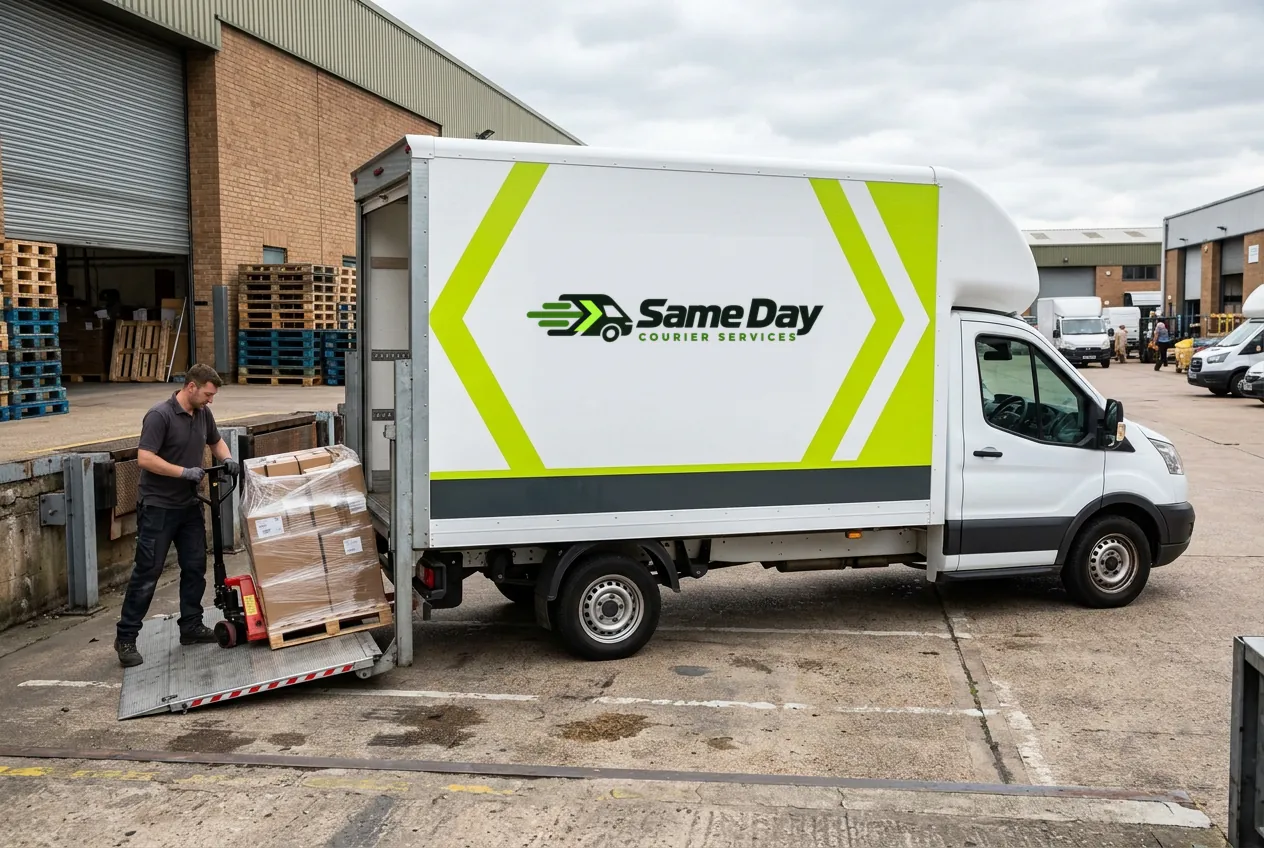
The part is in Warrington, the line is in Stoke
A servo drive fails on a packaging line mid-shift. The replacement is on a distributor's shelf 40 miles away, and their next-day carrier would get it to you tomorrow morning. Every hour in between costs you output, overtime and possibly a missed despatch to your own customer.
This is the work a dedicated courier is for. One van and one driver collect from the supplier and drive straight to your site. There is no depot, no sortation and no other customer's parcels on board, so the part does not sit anywhere waiting for a connection.
Line down: what happens after you call
- Give us the part and both addresses
Part description, boxed size and weight, the supplier's address and your order reference. We pick the smallest vehicle that suits it.
- Collection time confirmed
We confirm an estimated collection time when you book, based on where the nearest suitable vehicle is, and a fixed price before the van sets off.
- Driver collects against your reference
The driver quotes your order number at the trade counter. A quick call from you asking the supplier to have it packed saves time here.
- Direct drive, live updates
You can follow the job and plan the engineer's time around the arrival rather than waiting by the gate.
- Handover and signed proof of delivery
The driver hands over to the named person and records their name, the time and a signature, with a photo where useful.
Send it to the engineer, not to stores
Give us the maintenance engineer or shift manager as the delivery contact. A line-down part that is booked into general stores can sit on a goods-in bench while the line waits.
For the full picture of what we need from you on the phone, see what to have ready for a courier quote.
What manufacturers send with us
Typical manufacturing consignments are motors, gearboxes and other replacement parts, castings and fabrications, press tools and moulds, prototypes, and spares for planned shutdowns. Weight and the longest dimension usually decide the vehicle, so the table shows the van each one tends to need and what to tell us when you book.
| Consignment | Typical vehicle | What to tell us |
|---|---|---|
| Motors, gearboxes, pumps, bearings | Small van or SWB | Weight, and whether it is boxed or on a pallet |
| Castings and forgings from the foundry | SWB or LWB | Total weight: castings hit payload before space |
| Fabrications and welded frames | LWB or Luton | Longest dimension, and whether the paint is finished |
| Press tools, moulds and jigs | SWB or LWB | Weight, and that a forklift is available at both ends |
| Prototypes and pre-production samples | Small van | Fragility, orientation and who must sign |
| Shutdown spares and consumables | MWB or LWB | Number of pieces and any drop sequence |
These are typical choices; exact load space and payload depend on the vehicle model, and we confirm at booking. Our van size guide has the typical dimensions for each class.
Just-in-time supply without a buffer
Lean stock and kanban replenishment work well until a supplier short-ships, a batch fails inspection or a delivery is lost in a network. Then there is nothing on the shelf to cover the gap.
A dedicated van can collect the balance of a short delivery mid-shift, or bring a re-machined batch back from the subcontractor the same afternoon. Where the same gap keeps appearing, a fixed scheduled run between plant and supplier is usually cheaper than repeated emergency bookings. For parts that must be at the line before the morning shift starts, an overnight delivery gets them there in the small hours.
Tooling and subcontract runs
Much of a factory's transport never touches its own customers. Press tools go to the toolmaker for repair, moulds go out to a moulder, and machined parts move between plating, anodising, heat treatment and painting before they come home.
Tooling is heavy for its size. Put it on a pallet or timber skid so it can be lifted with forks, and tell us the weight so we can check it against the van's payload. Where the work is short, such as an inspection or a quick rework, ask us about the driver waiting and bringing it back, and we will include the expected wait in the price. A loop around several subcontractors can run as a single multi-drop route.
Getting through your goods-in
Factories run goods-in to protect stock accuracy and site safety, and a van that arrives without the right details can be turned away. Give us the following at booking:
What the driver needs for your site
- Goods-in opening hours, and who receives outside them
- Purchase order or booking-in reference for the delivery note
- Which gate to use, and the security or sign-in process
- PPE and induction rules for visiting drivers
- How the goods come off: dock, forklift or by hand
- A named contact with a mobile number
Shutdowns and planned maintenance often fall at weekends, so we run weekend collections and deliveries as normal. Parts to or from a European plant can travel by dedicated van into Europe, with the export paperwork prepared on your side before collection.
FAQ
Common questions
Can your driver collect a part we have just ordered over the phone from a distributor?
Yes. Give us the distributor's address, your order or collection reference and, ideally, the name of the person releasing the goods. The driver quotes that reference at the trade counter. It helps to ring the distributor yourself and ask for the part to be packed and waiting, so the van is not held at the counter. Tell us the weight and boxed size too, so we send a vehicle that suits the part rather than a guess.
How heavy a casting or press tool can you take?
It depends on the van. As a typical guide, an SWB van carries around 800–1,000 kg and an LWB around 1,100–1,300 kg, but exact payloads vary by model and we confirm at booking. Dense items such as castings and tools reach the weight limit long before they fill the floor. Anything one person cannot lift safely needs a forklift at both ends, and the item should sit on a pallet or skid so the forks can get underneath.
Our goods-in closes at 4.00 pm. What if the van is running late?
You will see that coming, because you get live updates during the job and we tell you as soon as an arrival time slips. That gives you time to arrange for maintenance or security to receive the part, or to agree a different handover point on site. For parts needed at the start of a shift, booking a late-evening or early-morning delivery from the outset is often the calmer option.
Do your drivers need a site induction or safety boots?
Many factories ask visiting drivers for hi-vis and safety footwear, and some require a short induction or a visitor sign-in. Tell us your site rules when you book and we will brief the driver and confirm they can meet them before the van sets off. If the driver must stay in a marked area or with the vehicle, say so, and we will pass that on as well.
Can you carry oils, coolants or gas cylinders with our spares?
No. We do not carry hazardous goods, so lubricants, coolants, solvents, aerosols and gas cylinders need a carrier set up for dangerous goods. Components should travel clean and drained. Where a repair needs fresh fluids on site, order them from a supplier who can deliver them separately, and send the hardware with us.
We send the same parts between our two plants most weeks. Can that be a regular run?
Yes. Recurring runs on fixed days, or a standing early-morning collection, are set up as scheduled courier work. The route, vehicle and contacts are agreed once, so you are not re-briefing a new booking each time. Approved businesses can also run this on a business account with invoicing.
Is a prototype covered for more than the value of its materials?
Every job includes goods in transit insurance as standard. Cover limits and exclusions are set out in our terms; tell us the value when booking and we will confirm cover, or arrange additional cover for high-value goods. For a one-off prototype, agree a value that reflects what it would cost to remake, not just the material.
Last updated