
Multi drop courier for planned delivery routes
One dedicated van, loaded with your goods only, delivering to several addresses in a sequence we agree with you. Timed drops where you need them, collections on the way, and signed proof of delivery at every stop.
- Your goods only, in your drop order
- Signed POD for each delivery
- Returns collected on the same route
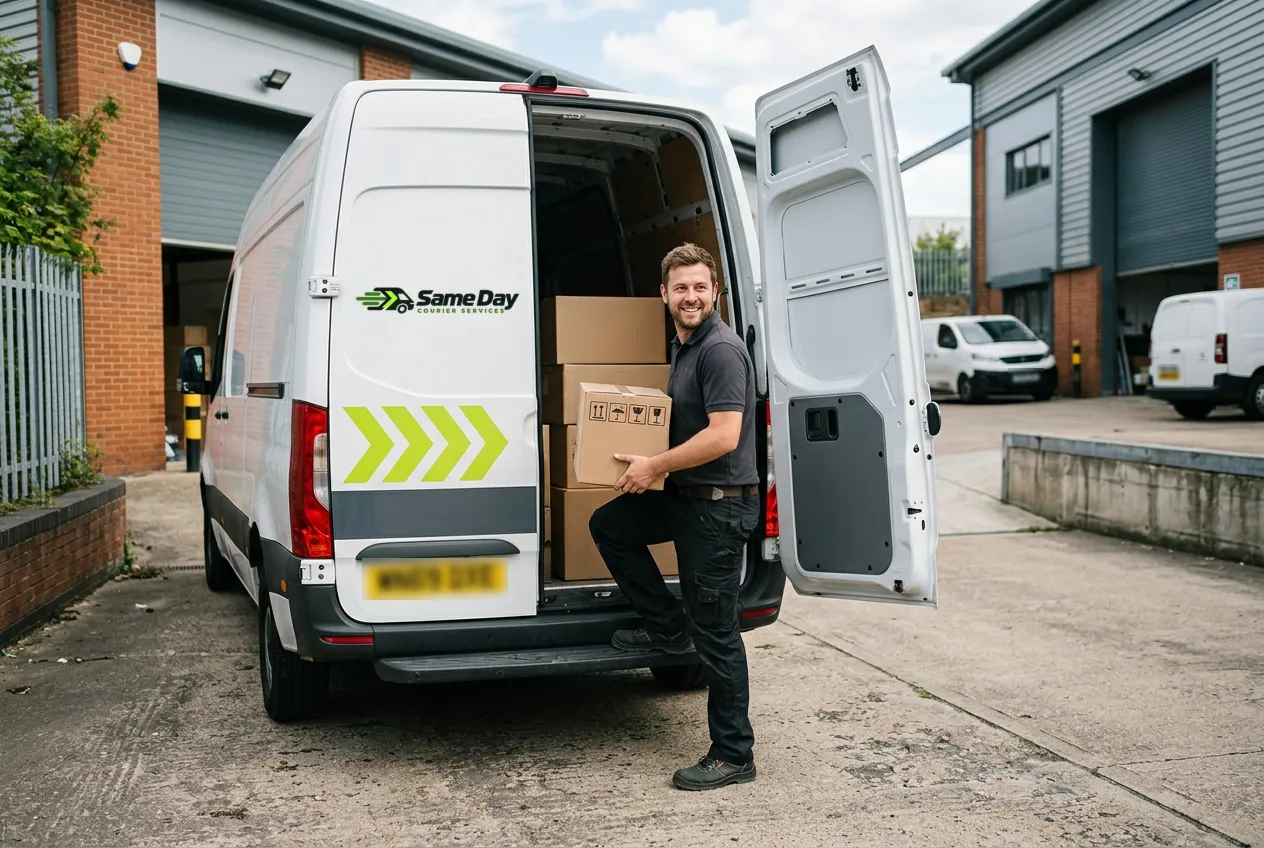
One van, several deliveries, your order
A multi-drop job uses one dedicated van and driver to deliver to several addresses on a single route. The van carries your goods only. It is loaded at your premises and the stops are made in a sequence we agree with you before it leaves.
That is the main difference from a parcel network, which also delivers multi-drop, but with your items mixed in with other senders' parcels, sorted through a depot and delivered in whatever order suits the network's round. With us you know what is on the van, the order of the drops and who is driving.
Planning the route
We plan the sequence from your list. Timed drops go in first, since they fix the shape of the day. The remaining stops are then ordered to keep the driving short and avoid doubling back.
Several things decide how many stops one vehicle can sensibly make:
- Distance between drops. A cluster on one industrial estate takes far less time than the same number spread across a county.
- Time at each stop. Handing over an envelope takes a minute. Carrying ten boxes to a first-floor stockroom takes much longer.
- Parking and access. City-centre shops without a loading bay, shopping centre service yards and timed loading restrictions all add time.
- Traffic and zones. In London, the Congestion Charge and ULEZ may apply and will be included in your quote. Some cities, such as Birmingham and Bristol, have Clean Air Zones.
If a list will not fit sensibly into one van's day, we will say so and suggest splitting it across two vehicles or two days.
What to send us
Send us a spreadsheet with one row per drop, giving the reference, recipient, full address and postcode, contact mobile, delivery window, item count, largest item, access notes and any returns. That is everything we need to plan the route and choose the vehicle, and it is the easiest way to book a multi-drop run. The columns:
| Column | Why we need it |
|---|---|
| Drop reference | Matches each delivery to your order or store number |
| Recipient or business name | So the driver asks for the right person |
| Full address and postcode | For route planning and navigation |
| Contact name and mobile | So the driver can call ahead or when they arrive |
| Delivery window | Fixed times, "not before" or "by" times |
| Item count and type | So the driver can check every drop is complete |
| Weight or size of the largest item | Needed to choose the vehicle |
| Access notes | Loading bay, stairs, lift, parking, opening hours |
| Collections or returns | Anything the driver should bring back |
Label every item with its drop reference before collection. If you can, load or stage the goods in reverse drop order, so the first delivery is nearest the doors. Our van size guide will help you check the total load fits.
Get a quote for this jobor call 020 4525 2039, any time
Proof of delivery at every drop
Each delivery gets its own signed proof of delivery: the recipient's name, the time and a signature, with a photo where useful. If a drop is refused, short or damaged, the driver records that against the drop reference rather than leaving you to find out later. You also get live updates as the route progresses. More on what POD captures is in our article on proof of delivery.
Collections and returns on the same route
A van that empties itself on the way out can carry something back. Common examples are empty cages and totes from stores, customer returns, faulty units for repair, unsold stock or event materials after the show. Put these on your spreadsheet as collections against the right stop, and the driver will collect, record and return them to you.
Where multi-drop works well
Retail store replenishment. A morning run from a warehouse to six or eight branches, dropping stock and collecting returns and empty cages. Our retail and ecommerce page covers store and online-order work more broadly.
Ecommerce batches. Bulky or fragile online orders, such as furniture, mirrors or large appliances, delivered to customers in one region on the same day, without the damage risk of a sorting depot. Each van normally has one driver, so heavy items need someone at each address to help unload.
Event and marketing literature. Brochures, leaflets, programmes and display stands delivered to venues, hotels or branches before an event or campaign launch. Printers often book these straight from the press; see our work for printing and publishing.
Branch and office distribution. Signed documents, IT equipment or uniforms delivered to several offices in one run.
If the same route runs every day or every week, set it up as a scheduled courier run with standing instructions, so you do not have to rebook it each time.
When a parcel network is the better choice
A parcel network is the better choice for hundreds of small parcels going to addresses across the UK, and widely spread drops are often better as separate jobs. Multi-drop by dedicated van suits routes with a manageable number of stops in one region, so it is not the right answer for every job:
- Hundreds of small parcels to addresses across the UK are cheaper through a parcel network.
- Drops spread from Cornwall to Scotland are usually better as separate dedicated courier jobs, or a network.
- Several drops that must all arrive at exactly the same time need one vehicle per drop.
Our guide to choosing a dedicated courier or a parcel network sets out where each one makes sense.
FAQ
Common questions
How many drops can one van do in a day?
It depends on how far apart the drops are, how long each one takes to unload, and the parking and access at each address. Twenty drops on one trading estate is a very different day from six city-centre shops with no loading bay. Send us the list and we will tell you whether it fits one vehicle, or whether it is better split.
How is a multi-drop job priced?
We price the whole route rather than each drop on its own. The main factors are total distance, the number of stops, time at each stop, the vehicle and any timed windows that fix the sequence. You get a fixed price for the route as described before the van is loaded. If you add drops later, we re-quote.
What happens if a recipient is not in?
The driver calls the contact number on your list, and we call you if there is no answer. You decide what happens next: try again later in the route, leave the goods with a named alternative, or bring them back. We only leave goods without a signature if you have given written instructions for that address.
Can I send you a spreadsheet of addresses?
Yes, that is the best way to book. One row per drop, with the address and postcode, contact name and mobile, delivery window, item count and any special instructions. A clear list cuts planning time and means the driver has the same information we do.
Can a drop have a fixed delivery time?
Yes. Timed drops are planned first and the rest of the route is built around them. Keep fixed times to the drops that really need them, because every fixed time limits how efficiently the rest of the route can be ordered. A window, such as 10.00 am to noon, is easier to plan than an exact time.
Can I add a drop after the van has left?
Often, if the goods are already on board and the new address is near the route. Call us as early as you can. Adding a stop may push later drops back, so we check the timed ones before agreeing and confirm any change to the price.
Last updated