
European courier service by dedicated van
One van and one driver collect from your UK premises and drive directly to the delivery address in Europe, by Eurotunnel or ferry. We plan the route and timing with you, and explain the customs paperwork needed before the van reaches the border.
- Direct from UK collection to EU door
- No hubs, no transfers between vehicles
- Customs requirements explained up front
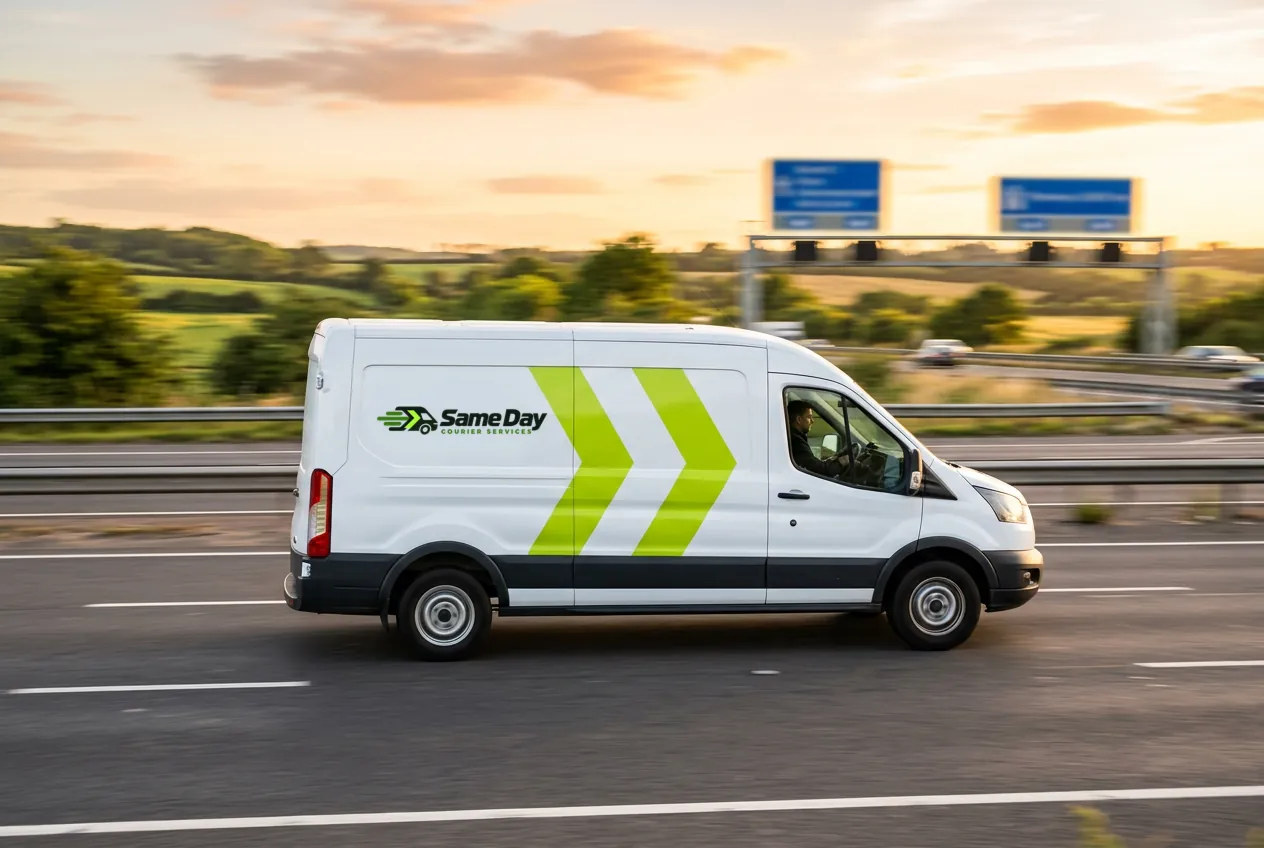
A UK van that goes all the way
A production line in Lyon is waiting for a replacement motor. A design studio in Shoreditch needs a model and display kit at a client's Amsterdam office for a Thursday pitch. A manufacturer in the Midlands has parts that missed the weekly groupage lorry to Stuttgart. A parcel network or shared freight load would add depot stops and days.
Our European service works the same way as our dedicated courier service in the UK. One van and one driver collect from your premises anywhere in mainland UK and drive directly to the delivery address in Europe. Your goods stay on the same dedicated vehicle for the whole journey as booked, with no cross-dock and no consolidation with other freight.
How the route works
Most European jobs leave Great Britain by Eurotunnel from Folkestone or by ferry from Dover, and the same van and driver then continue directly to the delivery address. We choose the crossing based on your collection point, destination and timing, and include its cost in your quote.
- Eurotunnel from Folkestone to Calais: quick and frequent, so it often suits urgent work.
- Ferries from Dover to Calais or Dunkirk, which give the driver a break.
- North Sea and western ferries, such as Harwich to the Netherlands or routes to Ireland, when they shorten the overall drive.
Typical timing, planned around distance
Rather than promise fixed transit times, we plan each job from the actual driving distance, the crossing, the customs process and the drivers' hours rules that apply. The table below gives typical planning examples from a collection in the South East.
| Destination area | Examples | Typical planning example (confirmed at booking) |
|---|---|---|
| Northern France, Belgium, southern Netherlands | Lille, Paris, Brussels, Antwerp, Rotterdam | often same day with an early start, otherwise next morning |
| Netherlands, western Germany, Luxembourg | Amsterdam, Cologne, Düsseldorf, Luxembourg City | usually next day |
| Central and southern Germany, eastern France | Frankfurt, Stuttgart, Munich, Lyon | next day to two days |
| Switzerland (outside the EU) | Basel, Zurich | next day to two days, plus Swiss customs formalities |
| Spain, Italy, Poland, Scandinavia | Madrid, Milan, Warsaw, Copenhagen | two days or more |
Switzerland is not in the EU or the EU customs union, so Swiss deliveries need their own import formalities, and usually a transit procedure across the EU on the way. Tell us at the quote stage if your goods are going there.
Collections from the North of England or Scotland add the drive to the Channel, which can be a full day in itself. Long routes need planned rest stops, and on international work vans over 2.5 tonnes follow the EU (assimilated) drivers' hours rules, which are stricter than the GB domestic rules. We build these into the timing and tell you at booking if an overnight stop is part of the plan.
Customs since Brexit: what has to be in place
Goods moving from Great Britain to the EU are exports from the UK and imports into the EU. Both sides need formalities. The export declaration, a goods movement reference and either an EU transit declaration or an import declaration must be in place before the van reaches the port; without them it will not be allowed to board. Where goods travel under transit, the EU import declaration is often completed inland at destination. Our guide to sending goods to Europe by road after Brexit goes into more depth; the essentials are below.
- EORI numbers. You need a GB EORI number as exporter, and the EU importer needs an EU EORI number.
- Commercial invoice. A full description of each item, quantity, value, currency, country of origin and the agreed terms of sale (Incoterms).
- Commodity codes. The correct tariff classification for each product line. A wrong code is one of the most common causes of a hold at the border.
- Export declaration. Lodged with HMRC before the goods leave Great Britain, normally by a customs broker acting for you.
- Goods movement reference (GMR). Created in HMRC's Goods Vehicle Movement Service to link the declarations to the van. Crossings through Dover and Eurotunnel need one; without it the van cannot board.
- Import declaration in the EU. Made by or for the importer, who pays any import VAT and duty. Under a transit procedure, this is often completed at or near the destination.
- Origin statement. If you want to claim zero tariff under the UK–EU trade agreement, the goods must meet the rules of origin and your invoice needs a valid statement.
Who acts as importer?
Your EU customer acts as importer under DAP (delivered at place) and handles import VAT and duty. Under DDP (delivered duty paid), you take on those costs and obligations, which usually needs an EU VAT registration or a representative who can act for you. Agree it with your customer before you book.
It is the question behind most last-minute problems, and a van sitting at Calais while two companies decide who pays the VAT is an expensive way to settle it.
Using a customs broker
Declarations are normally prepared by a customs broker, also called a customs agent. If you already use one, we work with them and share the vehicle and crossing details they need. If you don't, tell us when you ask for a quote and we will explain how the broker side will be arranged for your shipment. Either way, the broker needs your commercial invoice and EORI details well before collection.
Exhibition stands, demonstration equipment and tools going out and coming back may be better sent under an ATA Carnet, which avoids paying import duty on goods that are only visiting. Our events and exhibitions courier page covers show logistics in more detail.
Get a quote for this jobor call 020 4525 2039, any time
What can delay a border crossing
Most delays at the border come from paperwork rather than traffic: a missing export declaration or goods movement reference, invoice details that do not match the goods, or no agreed importer. Physical inspections, port queues, weather on the crossing and industrial action can also hold a van up. In more detail:
- an export declaration not lodged, or a missing or invalid goods movement reference (GMR);
- commodity codes, weights or values that do not match the declaration;
- an EU EORI number that is missing or invalid;
- regulated goods, such as food of animal origin or plants, without the right certificates;
- random physical inspections;
- peak holiday queues at Dover or Folkestone, passport checks under the EU's Entry/Exit System, or industrial action at the ports.
We plan around the predictable ones and keep you updated about the rest. Our article on common causes of courier delays explains what is in your control.
Ireland by ferry
The Republic of Ireland is in the EU, so a delivery to Dublin, Cork or Galway needs the same export and import formalities as a delivery to France. The van usually crosses from Holyhead, Fishguard, Pembroke or Liverpool, and sailing times shape the overall plan.
Northern Ireland is not in our standard coverage, and goods moving there follow different arrangements. If you need a Northern Ireland delivery, ask us before booking.
Choosing the right van
European jobs use the same vans as our UK work, from small vans for a box of parts to a Luton with tail lift for exhibition kit. Our van size guide gives typical load spaces and payloads, and if your consignment is palletised, our pallet delivery page explains loading and pallet counts. Chilled goods can travel in a refrigerated van; see our refrigerated courier page and mention the destination when you book.
For destinations outside Europe, or when road is simply too slow, our international courier service arranges air shipments through partner carriers.
What to send us for a quote
To quote, we need the collection postcode, the full EU delivery address, what the goods are with dimensions, weights and value, the ready time and the required arrival. Tell us whether you have a customs broker and who will act as importer, and we reply with a fixed price for the route.
Every job includes live updates and signed proof of delivery. Goods in transit cover is included, and our terms set out the limits, so give us the value with your quote request.
Request a European quote or call 020 4525 2039 and we will plan the route with you.
FAQ
Common questions
Can you deliver to Paris or Brussels on the same day?
Sometimes. If the goods are ready early, the customs paperwork is complete and the collection is in the South East, northern France, Belgium and the southern Netherlands are often reachable the same day, with Paris and Brussels typical examples. From further north in the UK, or with a later collection, next-morning delivery is the more realistic plan. We give you an honest estimate when you book.
Does my EU customer have to pay anything when the van arrives?
That depends on the terms of sale you agree with your customer. Under DAP terms, the EU recipient normally acts as importer and pays any VAT and duty. Under DDP terms, you as the sender take on those costs, which usually needs an EU VAT arrangement or a customs representative. Agree this with your customer before booking, because the broker needs to know who the importer is.
Do I need an EORI number to send goods to Europe?
Yes, for commercial exports from Great Britain you need an EORI number starting with GB, which you can apply for through GOV.UK. Your EU customer will need an EU EORI number if they are acting as importer. Without both, the export and import declarations cannot be made and the van cannot clear the border.
Can you collect from Europe and bring goods back to the UK?
Yes, we can quote for return loads, such as bringing exhibition kit home after a show or collecting a repaired part from a supplier in Germany. Imports into Great Britain need their own declarations, and the UK importer is responsible for any UK import VAT and duty. Tell us the collection address and the paperwork arrangements and we will quote the whole round trip.
Do you deliver to the Republic of Ireland and Northern Ireland?
We deliver to the Republic of Ireland by road and ferry, usually via the Welsh ports or Liverpool, and EU customs rules apply in the same way as for France or Germany. Northern Ireland follows different arrangements and is not part of our standard coverage, so please ask us about any Northern Ireland delivery before booking.
What kinds of goods are difficult to send to the EU by road?
Food of animal origin, plants and plant products, some medicines, alcohol and tobacco, and goods needing export licences all carry extra certificates or checks. Dangerous goods are outside our service. If your goods fall into a regulated category, tell us at the quote stage so your customs broker can confirm what is needed before collection.
Last updated