
Common causes of courier delays (and how to avoid them)
Most late deliveries are lost in the minutes before and after the drive: a vague address, goods still being packed, a blocked loading bay or a receiver that has closed. Here is what causes each delay and how to prevent it.
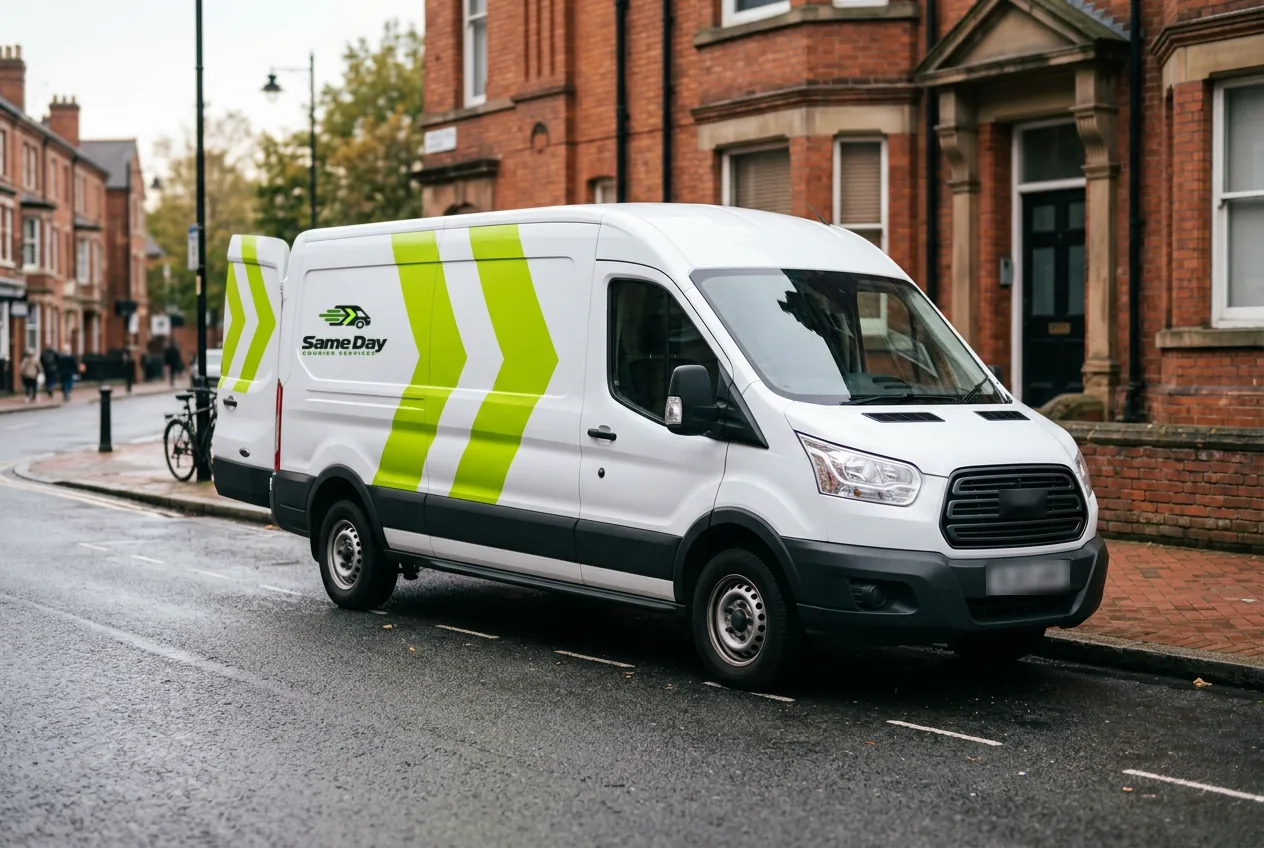
Why do courier deliveries run late?
Most late same-day deliveries lose their time either side of the drive: an address that sends the driver to the wrong building, goods still being packed, a loading bay nobody booked, or a goods-in door that shut at 3.00 pm. Traffic, weather and, on European jobs, border paperwork add to that. Ten minutes of preparation prevents most of it.
This guide takes each cause in turn: what it looks like on the day, why it happens and what you can do about it. It is written from the point of view of a dedicated courier service, where one van and driver go straight from collection to delivery, but most of the advice applies to any courier.
Delays at a glance
| Cause | Where it happens | What prevents it |
|---|---|---|
| Incomplete or wrong address | Collection and delivery | Full address, unit or building name, a contact who answers the phone |
| Access and loading problems | Collection and delivery | Details of bays, barriers, stairs, lifts, parking and lifting help |
| Goods not ready | Collection | Booking for the real ready time, packing before the van arrives |
| Receiver closed or absent | Delivery | Checking goods-in hours, naming an alternative recipient |
| Traffic, roadworks and incidents | On the road | Realistic delivery windows, avoiding peak hours where you can |
| Severe weather | On the road | Checking warnings, building in slack, agreeing a fallback |
| Customs paperwork | Port or border | Documents completed and checked before collection |
| Drivers' hours limits | Very long routes | Planning a second driver or an overnight stage |
Incomplete or inaccurate addresses
A postcode can cover an entire business park, a hospital with a dozen entrances or a rural lane where the houses have names instead of numbers. Sat-nav takes the driver to the postcode, not to the right door. On an industrial estate, "Unit 4" may be in Block C at the far end, behind a security gate. On a university campus, "main reception" can mean any one of five buildings.
Every one of those small mysteries costs time, and on a same-day job the time comes straight off the delivery window. The fix is simple: give the full address including unit, building, floor and department, the name of the person receiving the goods and a mobile phone number for someone on site who will actually answer. Add a line of directions if the entrance is not obvious ("goods-in is at the rear, off Station Road, not the front car park"). Our guide to what we need for an accurate quote covers the rest of the details worth having ready.
Access and loading at either end
Access problems tend to surface only when the van turns up. Common ones include:
- Car parks with height barriers that a high-roof van or Luton cannot pass under.
- Retail parks and shopping centres where deliveries need a booked loading bay slot.
- City-centre offices whose security desk wants the vehicle registration in advance.
- Pedestrianised high streets with loading permitted only at certain hours.
- Flats or offices on the third floor with no lift, or a lift too small for the item.
- Heavy items or pallets with no forklift or pallet truck at the delivery end.
A van normally has one driver. That driver can handle sensibly packed boxes, but a 150 kg machine part needs help at both ends, and a pallet needs a forklift, a dock or a tail lift. If you tell us about weight and access when you book, we can send a suitable vehicle (our van size guide shows which have tail lifts) and warn the receiver that they will need to help unload.
Goods that are not ready
This is the delay we see most often at collection. The driver arrives at the booked time and the part is still on the test bench, the documents are waiting for one last signature, or the boxes are packed but not taped and labelled. Twenty minutes lost at collection is twenty minutes lost at delivery, and for a tender that must be at a Leeds office by 4.00 pm that can be the difference.
Book for the time the goods will genuinely be ready, not the time you hope they will be. If the ready time slips, call us early: it is far easier to adjust a collection that has not started than to hold a driver who is already at your door. Our guide on getting goods ready for an urgent collection has a full packing and labelling routine.
The receiver is closed or nobody is there
We run 24 hours a day, seven days a week, but the place you are delivering to almost certainly does not. Goods-in departments often stop accepting deliveries well before the office closes. Construction sites lock their gates when the last trade leaves. Small businesses close early on Fridays, and many are shut on bank holidays.
Before you book, check three things: the receiving hours (not the office hours), whether someone specific needs to sign, and who else can accept the goods if that person is out. Agree with us what should happen if nobody is there: wait, try an alternative contact, hold and redeliver, or return. Each choice has a different cost, and deciding in advance avoids a driver sitting outside a locked unit while phone calls go unanswered.
Traffic, roadworks and incidents
A collision on the M6 near Birmingham, an overnight lane closure on the M1 that overruns into the morning peak, a football match letting out near the delivery address: road delays are the cause customers think of first, even though they are not always the biggest one. Rush hours around the larger cities, roughly 8.00 am to 9.30 am and 5.00 pm to 7.00 pm, slow everything.
You cannot prevent a crash, but you can plan around the predictable part. National Highways publishes planned roadworks and live travel updates for England's motorways and major A roads. Avoid booking a delivery for 5.30 pm across a city centre if 3.00 pm would do. With a dedicated driver, the van can be re-routed around a closure, and our live updates mean you will hear about a delay as it happens, not after the deadline has passed.
Severe weather
Snow on the M62 over the Pennines or the A9 north of Perth, dense fog, flooding on minor roads and high winds on exposed bridges all slow or stop vans. High-sided vehicles, which includes Luton vans, are often the first to be restricted when the wind picks up.
Check the Met Office weather warnings when you book something critical for the following day. If an amber or red warning covers the route, talk to us about collecting earlier, taking a different road or moving the delivery. A driver will not be asked to take risks to hit a time, and the receiver would rather know early that goods will be late than have them arrive damaged or not at all.
Border paperwork on European jobs
For goods heading into Europe, the most common hold-ups are documents rather than queues. A missing export declaration, an invoice with no commodity codes, the wrong EORI number or a goods movement reference that was never created can leave a van waiting at the port or refused boarding. The van is only as quick as the paperwork allows.
Have the commercial invoice, export declaration details and any licences or certificates complete and checked before the van collects. Our guide to paperwork for sending goods to Europe by road sets out who prepares what, and our European courier service page explains how we plan those routes.
Drivers' hours on very long routes
Van drivers in Great Britain work under the GB domestic rules: a maximum of 10 hours driving and 11 hours on duty in a day, as set out in the GOV.UK drivers' hours guidance. Most same-day jobs fit comfortably inside that. A late-afternoon booking from London to Aberdeen does not, once you allow for collection, loading, traffic and delivery.
For very long routes we plan the job properly at booking. That may mean a second driver, an overnight stage or a first-thing delivery the next morning. We will tell you which applies before you confirm, so you are not promised a time the law would not allow a single driver to meet.
A pre-booking checklist
- Full collection and delivery addresses, including unit, building and floor
- A named contact and mobile number at each end who will answer
- The real ready time for the goods, not the hoped-for one
- Receiving hours at the delivery address, and an alternative recipient
- Weight, dimensions and number of items, plus any pallets
- Access notes: height barriers, loading bays, stairs, lifts, parking
- Lifting help or equipment available at both ends
- Customs documents completed for any European delivery
- A fallback plan if nobody is available to sign
What to do when a delivery is running late
Talk to us first. We can give you the driver's position and a revised arrival time, which you can pass on to the receiver so they keep the goods-in door open or arrange for someone to stay. If the deadline is now at risk, decide together whether to carry on, redirect the goods to an alternative address or change the plan entirely.
Once the goods arrive, check the signed proof of delivery, which records who signed and when. If the job ran late, the timings on the proof of delivery and the updates during the job help you work out where the time went, so the same delay does not happen next time.
FAQ
Common questions
Can a same-day courier guarantee an exact delivery time?
No honest courier can control a motorway closure or a sudden snowfall. What a dedicated service can do is give you a realistic estimate at booking, keep you updated while the job is running and tell you straight away if the arrival time changes. For deadlines that cannot move, book with a margin of time built in rather than aiming at the last possible minute.
Who pays for waiting time if the goods are not ready?
In most cases the customer does, because the driver and van are committed to your job while they wait. Couriers usually allow a short free period and then charge for extra time, and the rules differ between firms. Ask how waiting time works before you book, and book for the time the goods will genuinely be ready.
What happens if the delivery address is closed when the driver arrives?
The driver will contact you and the receiver. The usual options are to wait until someone returns, deliver to a named alternative contact, hold the goods and redeliver later, or bring them back. Each option has a cost and a time impact, so agree a fallback when you book if there is any doubt about opening hours.
Are dedicated deliveries affected by bad weather in the same way as parcel networks?
Weather slows every vehicle on the road, but a dedicated van is not waiting for a trunking lorry or a hub sort, so one late connection does not hold your goods overnight. The driver can also take a different route if a road is closed. Very severe weather can still stop a job, and safety comes first.