
How to prepare goods for an urgent courier collection
Have the goods packed, labelled, measured and waiting by the door, with paperwork attached, a clear route for the driver and one named person who knows the job. Then the van can be loaded and away within minutes of arriving.
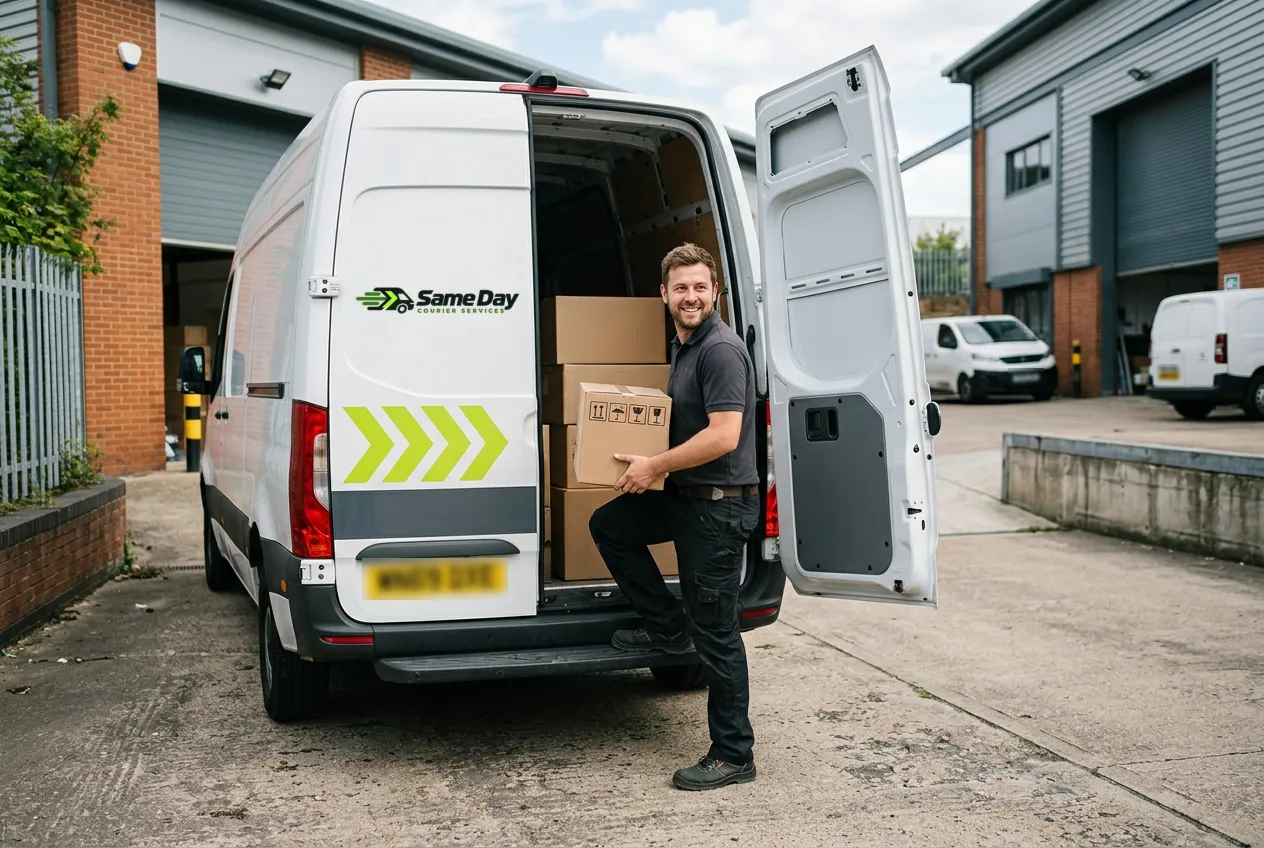
What being ready actually means
Being ready for an urgent collection means the driver can walk in, check the goods and load them without waiting for anything. In practice that is six things: goods packed and sealed, every piece labelled, paperwork attached, sizes and weights confirmed, a clear route from the vehicle to the goods, and one named person on site who knows the job.
Most urgent jobs are booked under pressure: a replacement pump for a stopped bottling line, signed contracts for a 4.00 pm completion, samples for a client meeting tomorrow morning. The van may reach you sooner than you expect, so start preparing the moment you decide to book an urgent courier, not when the driver rings to say they are outside.
Pack for the van, not the shelf
A dedicated van is gentler than a parcel network: your goods are not sorted, thrown or stacked with other people's freight. They still go through braking, cornering, speed bumps and motorway vibration for as long as the drive takes. Pack so that nothing inside the box can move and nothing outside it can puncture or crush it.
- Use a box that fits. Too big and the contents move about; too small and corners split. Double-wall cardboard for anything over about 10 kg.
- Fill every gap. Crumpled paper, air pillows or foam. If something rattles when you tilt the box, it needs more fill.
- Seal along every seam with proper packing tape, not office tape. Tape the centre seam and both edge seams top and bottom.
- Protect what sticks out. Pipe ends, shafts, connectors and corners get foam, card or bubble wrap.
- Keep liquids upright and sealed, with absorbent material in the box if a leak would damage anything else.
Breakables need more care than this, and our guide to packaging fragile items for courier transport covers glass, electronics and artwork in detail. Pallets have their own routine, set out in how to prepare a pallet for collection.
Label every piece
You do not need a printed courier label for a dedicated job, but you do need clear marking. A driver collecting from a busy warehouse may see 20 similar boxes, and a recipient's goods-in team may be receiving several deliveries at once.
Mark each piece, on the top and at least one side, with:
- The recipient's name and company.
- The full delivery address and postcode.
- A contact phone number at the delivery end.
- A piece number: 1 of 3, 2 of 3, 3 of 3.
- Handling marks where needed: this way up, fragile, do not stack.
Remove or cross out old labels and barcodes on reused boxes. An old address on a recycled carton is a common cause of a box being set aside at a goods-in desk.
Get the paperwork together
Put every document the driver or recipient will need into one clear plastic wallet or envelope, marked with the job reference, and keep it with the goods. Depending on the job, that might include:
| Consignment | Paperwork to have ready |
|---|---|
| Trade goods to a customer | Delivery note listing items and quantities; a copy for the recipient to sign if they need one |
| Repair or returns | Returns authorisation number, fault description, contact at the repair centre |
| Signed legal documents | Sealed envelope addressed to a named person, with an instruction on whether anyone else can sign |
| Goods for Europe | Commercial invoice, EORI number, commodity codes and any export documents from your customs agent |
| Chilled or medical goods | Temperature requirements, handling instructions, any records the recipient expects |
European consignments are the ones most likely to be held up by paperwork. The guide to sending goods to Europe by road after Brexit explains what is needed and who prepares it.
Confirm sizes and weights
Measure the largest piece (length, width and height, including any pallet base and overhang) and weigh it, or use the figures on the manufacturer's data sheet. Add up the total weight. If these figures differ from what you gave at booking, ring before the van arrives, because a vehicle chosen for 400 kg of boxes may not be right for 900 kg.
Check the route out of the building too. A crate that fits the van will not help if it does not fit through the fire door between the workshop and the yard. Measure doorways, lift cars and stairwell turns for anything large.
Clear the way for the driver
Think about the driver's first five minutes on site and remove anything that slows them down.
- Where to stop. The nearest loading bay, the rear yard, or the closest legal place to pull in. Tell us about height barriers, narrow gates and red routes.
- How to get in. Gate codes, intercom numbers, which door to use, and whether the driver must sign in at reception.
- Site rules. Construction sites and some factories require hi-vis, safety boots or a short induction. Tell us when you book so the driver arrives prepared.
- Where the goods are. Ideally on the ground floor, near the exit, on a trolley or pallet. Goods still on a mezzanine behind a locked cage add time on every job.
- Who lifts. One driver usually attends. For anything one person cannot handle safely, have a forklift, pallet truck or a colleague ready. HSE's manual handling guidance is a sensible reference for deciding what counts as safe.
Name one contact person
Give us one person at the collection address who will answer their mobile, knows where the goods are and has authority to release them. That last point is easy to forget. A receptionist who has not been told about the collection will reasonably refuse to hand over a box of laptops to someone they do not recognise.
Brief that person on the piece count, the paperwork and anything unusual, such as a box that must stay upright. Do the same at the delivery end, because a named recipient who knows the delivery is coming is the quickest way to a signed proof of delivery.
Take handover photos
Photos taken just before the driver loads the goods are the best evidence you can have if anything is disputed later. They take two minutes and cost nothing.
- Every side of each box or crate, with the label readable.
- Pallets from two opposite corners, showing the wrap and any strapping.
- Serial numbers, asset tags or seals on equipment and high-value items.
- Existing marks or scuffs on unwrapped items such as furniture or machinery.
- The goods loaded in the van, if the driver is happy for you to take one.
Keep the original files rather than screenshots, because the original carries the date and time. Store them with the job reference until the delivery is confirmed and any claim period has passed.
Special consignments
Some goods need preparation that goes beyond packing well.
Medical samples. Diagnostic specimens sent as UN3373 Biological Substance, Category B must be triple-packaged by the sender to packing instruction P650, with the correct marking on the outer box. We carry properly packaged consignments; packing them is the sender's job. Our medical and pharmaceutical courier page explains how these jobs work.
Chilled goods. Keep them in your fridge or cold room until the driver arrives, and tell us the temperature range at booking so the load area of the refrigerated van can be brought to temperature before loading. Typical chilled ranges are 2–8 °C, and the exact range is agreed with you when you book.
High-value goods. Avoid labels or markings that advertise the contents, declare the value at booking, and photograph serial numbers.
Five minutes before the van arrives
Final check
- Every piece packed, sealed and passing a tilt test with no rattling
- Each piece labelled with address, contact and piece number
- Paperwork in one marked envelope with the goods
- Goods at ground level near the exit, with lifting help arranged if needed
- Contact person briefed, on site and answering their mobile
- Handover photos taken and saved
If something on that list cannot be done in time, call us before the driver arrives. A ten-minute warning is far easier to work around than a surprise at the door. For what happens once the driver is with you, see how same-day courier collections work.
FAQ
Common questions
Do I have to be there in person when the courier collects?
No, but someone must be. The person releasing the goods should know what is going, how many pieces there are and where the paperwork is. A colleague, a receptionist or a neighbouring unit can do it if you brief them properly. Give us their name and mobile number at booking rather than your own if you will not be on site.
Should I tell the courier what the goods are worth?
Yes. Goods in transit cover is included as standard, but cover limits and exclusions are set out in our terms. Tell us the value when booking and we will confirm the cover, or arrange additional cover for high-value goods. Declaring the value also helps the driver understand how carefully the consignment needs handling and where it should sit in the van.
What if the item turns out bigger than I said at booking?
Tell us as soon as you realise. If it still fits the vehicle we sent, the job usually goes ahead, though a significant change in size or weight can change the price. If it does not fit, the options are a larger vehicle or a second one, both of which add time. A quick measurement before you book avoids this entirely.
Can I hand the driver goods that are still warm from production or wet from cleaning?
It is better not to. Warm items sealed in plastic can sweat, and damp cardboard loses most of its strength, so boxes can collapse in transit. Let items cool and dry before packing, or tell us at booking if there is a reason they cannot wait, such as chilled food that must go straight into a refrigerated van.