
How many pallets fit in a van?
As a typical guide: one UK pallet in a small van, two in a short-wheelbase van, two or three in a medium-wheelbase, three in a long-wheelbase and up to five in a Luton. Weight and height often run out before floor space does.
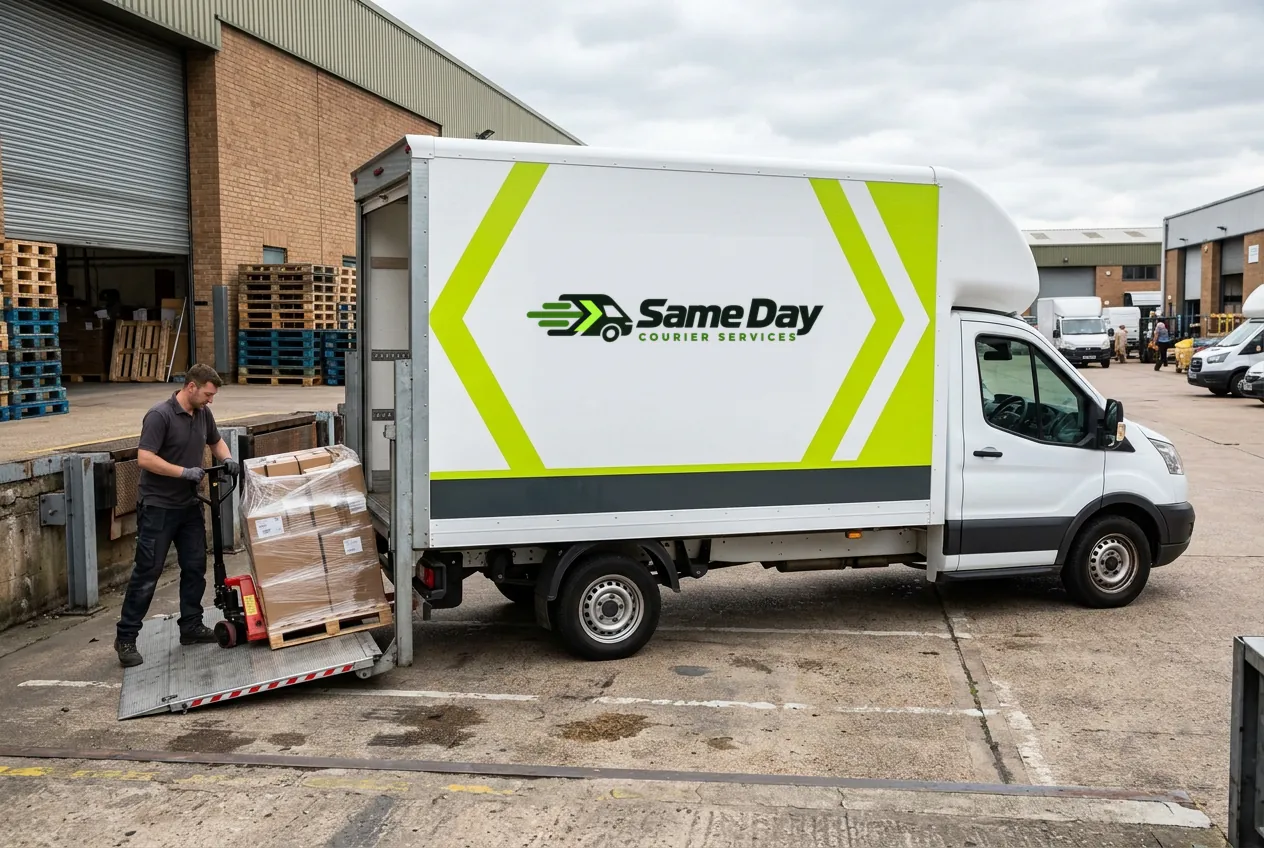
The short answer
As a typical guide, a small van takes one UK standard pallet, a short-wheelbase (SWB) van two, a medium-wheelbase (MWB) van two or three, a long-wheelbase (LWB) van three and a Luton van up to five. Those numbers are about floor space only. In practice the deciding factor is usually weight, then height, then whether the pallets can physically be loaded through the doors.
Every number in this guide is a typical value. Vans of the same class still vary by manufacturer and specification, so we confirm which vehicle suits your pallets at the booking stage.
UK and Euro pallet sizes
Two pallet footprints dominate in the UK, and they behave differently in a van because their widths differ.
| Pallet | Footprint | Where you see it |
|---|---|---|
| UK standard | 1,200 × 1,000 mm | Most UK manufacturing, wholesale and pallet networks |
| Euro (EUR) | 1,200 × 800 mm | European supply chains, retail and drinks |
| Euro half (display) | 800 × 600 mm | Retail displays and smaller consignments |
The word "half" causes confusion. UK pallet networks often use "half pallet" and "quarter pallet" to describe height and weight bands on a full-size base, not a smaller pallet. Published network limits typically allow a full pallet up to roughly 1,000 kg and 2.0 metres tall, about 500 kg and 1.1 m for a half, and about 250 kg and 0.8 m for a quarter, although each network sets its own rules. When you book a van, describe the actual pallet: its footprint, its height including the pallet itself, and its weight.
Pallets per van, vehicle by vehicle
This table uses the typical load space and payload figures from our van size guide. The Euro pallet column is a floor-space estimate assuming the load space between the wheel arches is wide enough to take the pallet's 1.2 m length across the van.
| Van | UK pallets (1,200 × 1,000) | Euro pallets (1,200 × 800) | Goods weight it will take | Floor length, width, height |
|---|---|---|---|---|
| Small | 1 | 1 (two rarely practical) | 500 kg or so | 1.8 m, 1.2 m, 1.1 m |
| SWB | 2 | 2–3 | 800 kg to 1 tonne | 2.4 m, 1.6 m, 1.3 m |
| MWB | 2–3 | 3 | 1 to 1.2 tonnes | 2.9 m, 1.7 m, 1.6 m |
| LWB | 3 | 4 | 1.1 to 1.3 tonnes | 3.4 m, 1.7 m, 1.8 m |
| Luton (tail lift) | up to 5 | up to 6 | roughly 1 tonne | 4.0 m, 2.0 m, 2.0 m |
Two cautions apply to every row. First, wheel arches intrude into the load floor in panel vans, so the usable width at floor level is narrower than the widest point. Second, pallets cannot be stacked on top of each other in a van unless they were built and wrapped to be stacked and the weight allows it, which is rare for same-day work.
Why payload usually runs out first
Vans in this range have a gross vehicle weight of up to 3.5 tonnes. Take away the weight of the empty van, its driver and the diesel, and what remains is the payload, which is why a "3.5-tonne van" never carries anything like 3.5 tonnes of freight. In the table above, nothing carries much more than 1.3 tonnes.
Pallets get heavy quickly. A pallet of boxed paper, bagged aggregate, floor tiles or bottled drinks can easily weigh 600 kg or more. Two of those exceed the payload of most SWB vans before the floor is even half full. On the other hand, a pallet of packaging, foam or exhibition graphics may weigh under 100 kg, and then floor space and height become the limits instead.
The practical rule is to add up the total weight of all the pallets, including the pallets themselves (a wooden pallet typically weighs 20–30 kg), and choose a vehicle by that figure first.
Height, doors and how pallets get in
Internal height is only part of the story. The rear door opening on a panel van is lower than the roof inside, and some vans have a bulkhead or roof lining that reduces height further at the front. A pallet built close to the internal height may fit inside a van but not pass through its doors, or may not clear the forklift mast and the door frame at the same time. Tell us the built height of each pallet and we will check it against the door opening of the actual vehicle, not just the figures in the table.
Loading method matters too:
- Rear loading by forklift is the normal way into a panel van. The forklift places each pallet and the driver may slide it forward with a pallet truck if the floor allows.
- Side loading is possible on some panel vans through the sliding side door, but the opening is narrower than the rear doors and often too narrow for a pallet's full width.
- Tail lift loading is the reason to choose a Luton when there is no forklift. Most Luton lifts are good for around 500 kg, and you still need a pallet truck to roll the pallet onto the platform and off again.
- Loading docks suit vans less well than lorries, because a van's floor is lower than a dock's. A dock leveller or a forklift still tends to be needed.
Worked examples
These examples use the typical figures above. They are illustrations, not a substitute for confirming the vehicle when you book.
Two UK pallets of boxed electronics, 300 kg each, 1.4 m high. The weight (600 kg plus pallets) is fine for an SWB van, but 1.4 m is too tall for its typical 1.3 m load height. An MWB or LWB van is the better choice.
Three UK pallets of print, 350 kg each, 1.5 m high. That is 1,050 kg of goods plus about 75 kg of pallets, roughly 1,125 kg. Three pallets fit an LWB by floor space and the height is within limits, but the weight is close to the lower end of the LWB payload range. We would check the specific vehicle's payload before confirming.
Four Euro pallets of bottled drinks, 450 kg each. That is 1,800 kg of goods, which exceeds the payload of every van in the table. The load needs to be split across two vehicles, or sent by a pallet network if it does not need to arrive the same day.
Five UK pallets of exhibition stands, 140 kg each, 1.8 m high, delivered to a venue with no forklift. A little over 800 kg in total including the pallets, five pallets by floor space, tall loads and no forklift at the far end: a Luton with a tail lift is the natural fit. Our events and exhibitions page covers venue timings and access.
Measure the built pallet, not the empty one
Give us the height measured from the ground to the top of the wrapped goods, and the footprint including any overhang. A pallet that started at 1,200 × 1,000 mm can be wider once boxes overhang the edge, and that can stop two pallets fitting side by side.
What to tell us when you book
Tell us how many pallets there are and their type, the weight of each including the pallet, and its built height from the floor. Add whether the load is fragile, what loading and unloading equipment is at each end, and any height barriers. That lets us send a van that is neither too small nor overloaded.
:::checklist Easy to forget
- Whether the load must not be tipped
- Whether there is a forklift, pallet truck, dock or nothing at collection
- The ground surface at delivery, if the pallet has to be moved off the vehicle
- Any access restrictions at either end ::: Our pallet delivery service page explains how dedicated same-day pallet jobs run, and getting a pallet ready for the driver covers stacking, wrapping and labelling. For loads that are bulky but not palletised, see our large item courier service.
FAQ
Common questions
How many pallets fit in a Transit-sized van?
It depends on the wheelbase. A typical short-wheelbase van takes two UK standard pallets, a medium-wheelbase two or three, and a long-wheelbase three. Euro pallets are narrower, so one more may fit on the floor. In every case, check the combined weight against the payload and the pallet height against the rear door opening, not just the internal roof height.
Can a Luton van really take five pallets?
By floor space, a Luton can usually take up to five UK standard pallets. By weight, often not: a typical Luton payload is around 1,000 kg, so five pallets would need to average about 200 kg each. Five pallets of light exhibition stands is realistic; five pallets of boxed tiles is not.
What loading equipment is needed at each end for a pallet van?
For a panel van, yes, or a loading dock at the right height. Pallets usually go in through the rear doors by forklift. A Luton with a tail lift can lift a pallet from the ground, typically up to about 500 kg, as long as there is a pallet truck and a flat, hard surface to move it on.
Are Euro pallets and UK pallets interchangeable in a van?
They share the 1,200 mm length but a Euro pallet is 800 mm wide against 1,000 mm for a UK standard pallet. That difference changes how many fit side by side or end to end, so always tell us which type you are sending, along with the number, weights and heights.