
How to prepare a pallet for courier collection
A pallet ready for collection sits on a sound base, is stacked square within its footprint, is wrapped and strapped tightly, carries labels on two sides and waits next to a forklift or pallet truck. Here is how to get each step right.
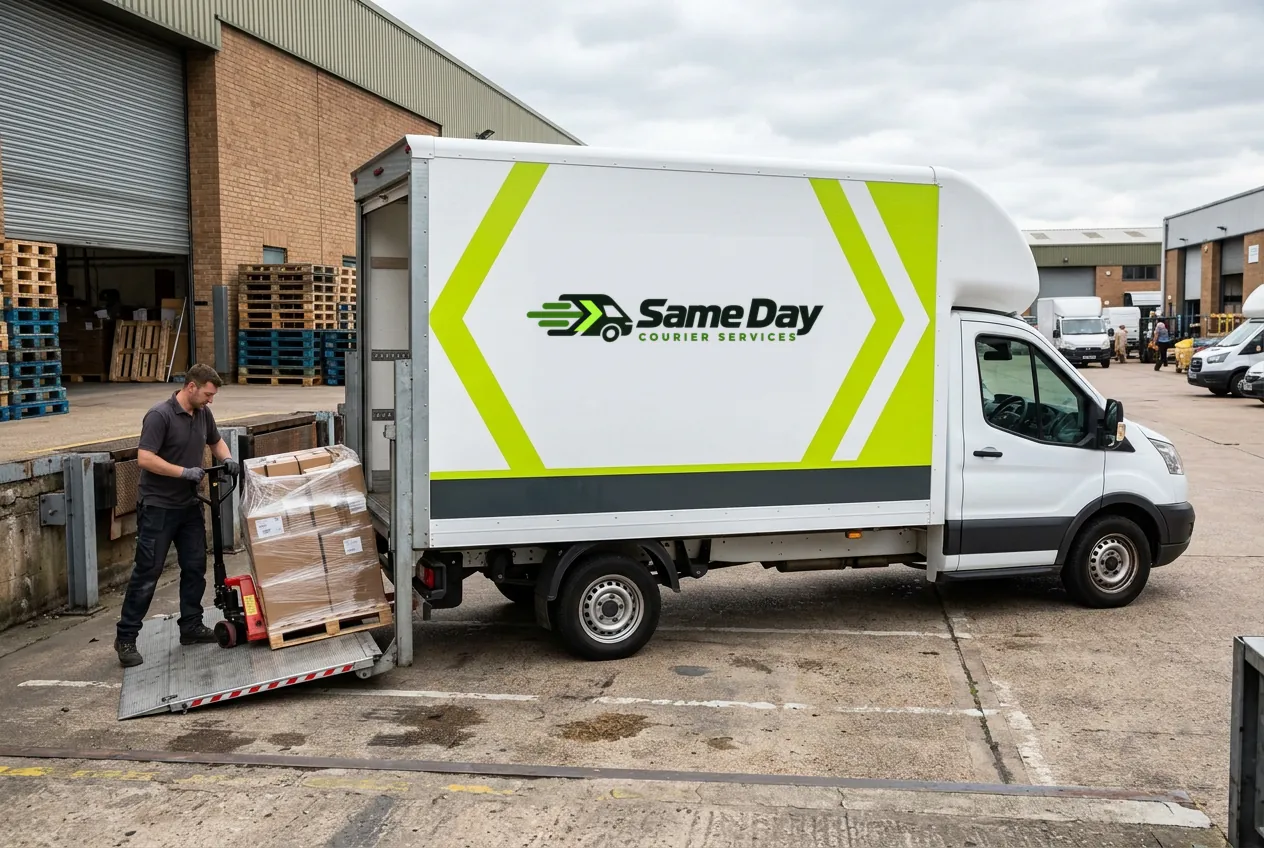
What a collection-ready pallet looks like
A collection-ready pallet is a sound pallet of the size you booked, with the goods stacked square and nothing over the edges. It is within the vehicle's height and weight limits, wrapped (and strapped if heavy) so it moves as one block, labelled on two sides, and waiting with its paperwork and a forklift or pallet truck.
Getting those right protects the goods, keeps the driver and your staff safe, and avoids the most common reason a pallet collection runs late: the driver arriving to find the pallet still being built.
Start with a sound pallet
Before you stack anything, inspect the pallet itself. Turn it down if you find:
- Cracked, split or missing deck boards, top or bottom.
- Missing or crushed blocks between the decks.
- Protruding nails or loose fixings.
- Signs of rot, heavy oil contamination or water damage.
- A size that does not match what you booked.
The two common sizes in the UK are the UK standard pallet at 1,200 × 1,000 mm and the Euro pallet at 1,200 × 800 mm. Use the size you told the courier about, because it affects which vehicle is sent and how many pallets fit. Our guide to how many pallets fit in a van explains why the difference matters.
For export loads, wooden pallets moving from Great Britain to the EU must meet the ISPM 15 standard and carry its treatment mark. Check before building a European consignment on an old or unmarked pallet.
Stack the load properly
How you stack decides how well the load survives braking, cornering and the forklift.
- Heaviest at the bottom. Put dense, strong cartons on the lower layers and lighter ones above.
- Keep within the footprint. Nothing should overhang the pallet edges. Overhanging boxes lose the support of the deck and get crushed or snagged.
- Build a flat top. A level top layer spreads the pressure of straps and protects the load from anything placed nearby.
- Fill gaps. Use void fill or cardboard so boxes cannot shift into empty spaces.
- Keep it square. Lean or bulge in a stack only gets worse once the van is moving.
There are two basic stacking patterns, and each suits a different kind of load.
| Pattern | How it works | Best for | Watch out for |
|---|---|---|---|
| Column stacking | Boxes sit directly on top of the box below, corners aligned | Maximum crush strength for heavy cartons | Columns can separate unless wrapped and strapped well |
| Interlocking (brick) stacking | Each layer is rotated or offset so boxes bridge the joins below | Stability for lighter, mixed or uneven loads | Less vertical strength, as box corners do not line up |
For fragile items, our guide to packaging fragile items for a courier covers inner packing, which matters even more once boxes are stacked several layers high.
Keep to height and weight limits
The vehicle sets the real limits. For same-day work in vans, height is restricted by the internal height and the rear door opening, and weight by the van's payload. A pallet that would be acceptable to a lorry-based pallet network can be too tall or too heavy for a panel van.
| Limit | Typical figure | Why it matters |
|---|---|---|
| Full pallet in pallet networks | about 1,000 kg and 2.0 m high | A common network benchmark, not a van limit |
| SWB van load height | about 1.3 m | Taller pallets need a larger van |
| LWB van load height | about 1.8 m | Door opening is lower than the internal height |
| Luton van load height | about 2.0 m | The usual choice for tall pallets |
| Luton tail lift rating | about 500 kg | Heavier pallets need a forklift at both ends |
These are typical figures and vary with the vehicle. Weigh the finished pallet if you can, and measure its height from the floor to the highest point of the wrapped load. Our van size guide sets out payloads for each vehicle class, and we confirm the right one when you book.
Wrap and strap it
Stretch wrap holds the load together and keeps out dust and light rain. To wrap well:
- Tuck the end of the film into the base and make three or four turns around the bottom, catching the pallet's top deck so the load is tied to the pallet.
- Spiral upwards, overlapping each pass by roughly half the film width and keeping the film under tension.
- Add extra turns at the top, and fold a top sheet of cardboard under the final layers to protect the top and shed water.
- Spiral back down to the base for a second layer on heavy or tall loads.
Wrap alone is rarely enough for heavy, dense or slippery goods such as bagged products, cans or drums. Add polypropylene or polyester strapping, usually at least two straps in each direction, running under the top deck of the pallet. Put edge protectors (cardboard or plastic corner boards) on all four vertical corners and under every strap where it crosses the top edge. They stop straps cutting into cartons and give the load rigidity.
Give the pallet a firm push at shoulder height. If anything moves independently of the pallet, add more wrap or another strap.
Label at least two sides
A pallet with one label facing a wall is as good as unlabelled. Fix a label to at least two adjacent sides so it can be read whichever way the pallet is approached. Each label should show:
- The delivery address and the receiver's name and phone number.
- Your collection address and a contact name.
- Your reference or order number.
- The pallet count, for example "Pallet 2 of 3".
- The gross weight.
- Handling marks where needed: "Fragile", "This way up", "Do not stack".
Apply labels over the final layer of wrap, or inside a clear document pocket, so they are not hidden or torn off during wrapping.
Have the paperwork ready
Keep a delivery note or packing list for each pallet, ideally in a pocket on the pallet and with a copy for the driver. If the consignment is valuable, tell us the value when booking so we can confirm cover or arrange additional cover. For loads heading into Europe, the commercial invoice and export documents must be ready before collection; our European courier service page explains what that involves.
Line up loading equipment at both ends
Pallets need equipment to move. The driver will position and secure the load in the van, following the principles in DVSA's guidance on securing loads, but the pallet has to get to the van first.
- Forklift: the standard way to load a panel van through the rear doors. Make sure a trained operator is available at the booked time.
- Pallet truck: needed to move pallets on a tail lift and across the van floor. It needs a firm, level, smooth surface: gravel, grass and steep slopes do not work.
- Tail lift: if there is no forklift at one end, book a Luton with a tail lift, typically rated to about 500 kg.
- Hand unloading: a last resort. Breaking a pallet down by hand takes time and creates manual handling risk; HSE's manual handling guidance explains why employers should avoid hazardous lifting where possible.
Check the delivery end as carefully as the collection end. Many failed pallet deliveries happen because the receiving site assumed the van would have a tail lift, or the driver arrived to find no forklift and a gravel yard. Engineering and manufacturing sites usually have the kit; offices, shops and building sites often do not. Our manufacturing and engineering courier page covers typical factory-to-factory moves.
Final checklist before the van arrives
- Pallet inspected and the size matches the booking
- Load stacked square, heaviest at the bottom, nothing overhanging
- Height and weight measured on the finished pallet
- Wrapped from the base, with a top sheet, and strapped if heavy
- Edge protectors on the corners and under straps
- Labels on two sides, with pallet count and weight
- Delivery note and any export documents ready
- Forklift or pallet truck and operator ready at collection
- Unloading equipment and a contact confirmed at delivery
With those boxes ticked, the driver can load, secure and leave within minutes. To book a same-day move, see our pallet delivery service.
FAQ
Common questions
How much stretch wrap does a pallet need?
Enough that the load and the pallet move as one block. Start with several turns around the base, catching the top deck boards of the pallet, then spiral upwards overlapping each pass by roughly half the film width, and finish with extra turns at the top. Heavy or slippery loads also need straps. If you can rock the boxes by hand, add more wrap.
Can I put a pallet on top of another pallet in the van?
Only if the lower pallet was built to take the weight, both are wrapped flat and square, and the combined height and weight suit the vehicle. For most same-day jobs we keep pallets single-stacked on the floor, which is safer for the goods and easier to secure. Tell us at booking if your pallets are designed to be stacked.
Do I need a forklift if the courier sends a tail-lift van?
Not necessarily. A Luton with a tail lift can raise a pallet from ground level, typically up to about 500 kg, but someone still has to move the pallet on and off the platform with a pallet truck, on firm and level ground. A heavier pallet, or one on gravel or grass, needs a forklift.
Are there extra rules for wooden pallets going to Europe?
Yes. Wood packaging, including pallets, moving from Great Britain to the EU must meet the ISPM 15 international standard, which means it has been treated and carries the official mark. Most new pallets from reputable suppliers are marked, but check before you build an export load on an old or unmarked pallet.