
How same-day courier collections work in the UK
You book with the addresses, goods details and timings, a suitable vehicle comes to you, the driver checks and loads the consignment, then drives straight to the recipient, who signs for it. This guide walks through each stage.
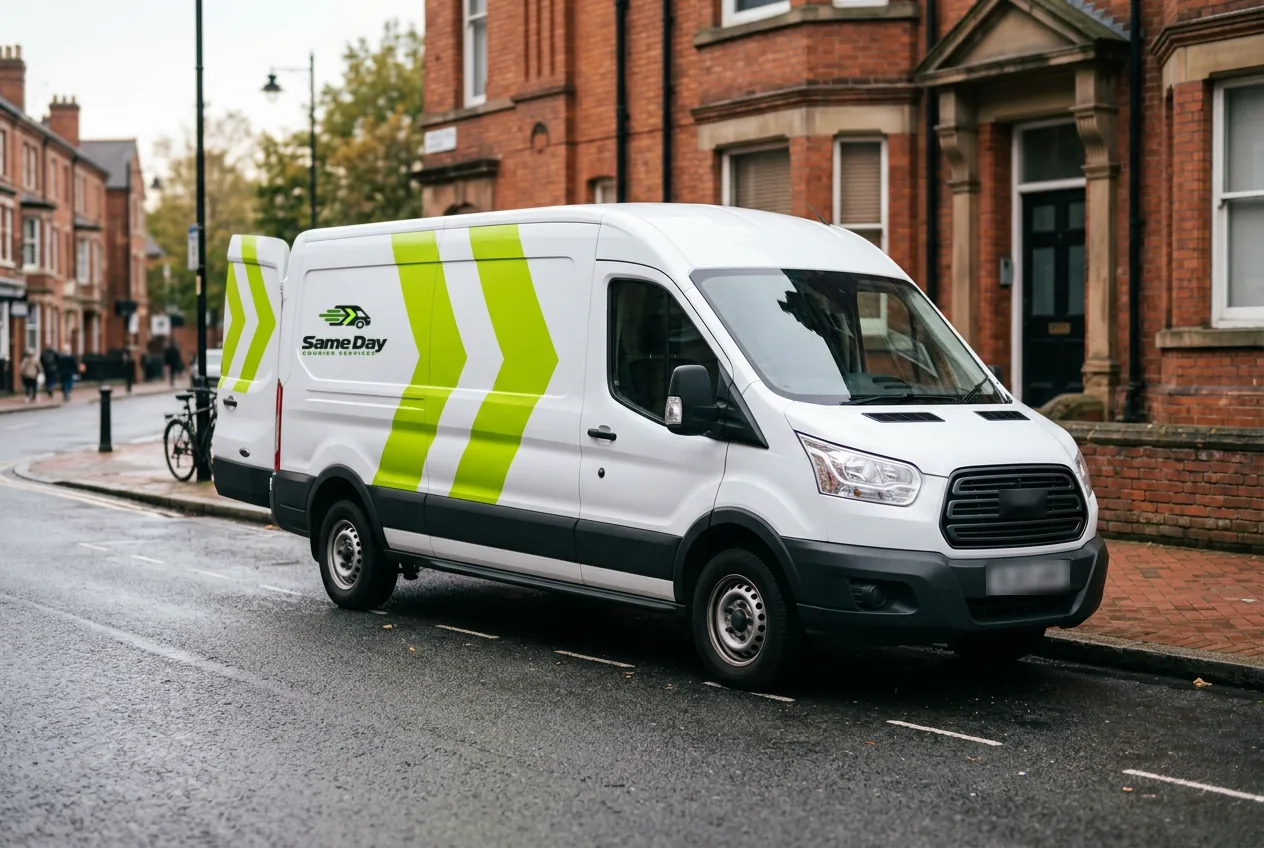
How a same-day collection works, in brief
You tell the courier where the goods are, where they are going, what they are and when they must arrive. The courier agrees a price and sends the nearest suitable vehicle with an estimated collection time. The driver checks and loads the goods, drives directly to the delivery address, and the signed proof of delivery comes back to you.
With a dedicated courier, there is no depot in the middle. The van that collects your consignment is the van that delivers it, and nobody else's goods are added on the way. That is what makes same-day possible, and it is also why the details you give at booking matter so much: the vehicle is chosen for your job alone.
The collection process, step by step
- You book the job
You give both addresses with postcodes, contact names and mobile numbers, a description of the goods with sizes and weights, the time they will be ready and the latest delivery time.
- A fixed price is agreed
The price is based on distance, vehicle size, timing and any extras such as a return leg or extra drops. It is agreed before the vehicle is sent.
- A vehicle is allocated
The job goes to the nearest suitable vehicle, and you get an estimated collection time based on where that vehicle is.
- The driver arrives
The driver reports to your named contact, confirms the booking reference and finds out where the goods are.
- Checks and loading
The driver counts the pieces, looks at the packaging and paperwork, notes any existing damage, then loads and secures everything.
- Direct drive with updates
The vehicle goes straight to the delivery address. You receive updates while the job is live.
- Delivery and proof
The recipient checks the consignment and signs. The proof of delivery records their name, the time and their signature, with a photo where useful.
What happens before the van arrives
Once the booking is confirmed, the job is matched to a vehicle that is the right size and close enough to reach you quickly. You get an estimated collection time based on that vehicle's position, not a promise made before anyone has looked at the map.
There is nothing to print. The driver carries the job details on a mobile device, including your contact's number, so they can call ahead if the entrance is hard to find. For a timed collection booked in advance, the vehicle is planned around the ready time you gave us, so make that the time the goods will actually be packed and waiting.
What the driver checks at collection
A few minutes of checks protect both sides: a problem is far easier to fix in your loading bay than at a delivery address 150 miles away.
| Check | What the driver looks for | Why it matters |
|---|---|---|
| Piece count | The number of boxes, pallets or items matches the booking | A missing box found at delivery cannot be fixed quickly |
| Size and weight | The goods fit the load space and stay within the vehicle's payload | An overloaded van is unsafe and illegal to drive |
| Packaging | Boxes sealed, nothing leaking, contents protected and immobilised | Damage caused by poor packing is commonly excluded from cover |
| Labels | Each piece marked with the delivery address and a piece number | Stops items being mixed up on multi-drop runs or at busy goods-in bays |
| Existing damage | Crushed corners, dents, torn wrap or scuffs on unwrapped items | Recorded before departure so it is not later blamed on transit |
| Paperwork | Delivery notes, handling instructions, customs documents for Europe | Missing documents can stop a recipient or a border accepting the goods |
| Handover | Name of the person releasing the goods | Starts the record of who held the consignment and when |
After the checks, the driver loads and secures the goods so they cannot shift under braking or cornering, using straps, load bars and blankets as needed. Securing a load properly is a legal duty for anyone operating a goods vehicle, and the GOV.UK load securing guidance covers vans as well as lorries.
Who does the lifting
A same-day van normally comes with one driver, and the driver will load what one person can handle safely. The law does not set a fixed weight limit for lifting: HSE manual handling guidance asks employers to assess the load, the task and the environment instead. Anything heavier or more awkward needs lifting help planned at your end.
In practice, a 30 kg server on the ground floor is a one-person job. A 180 kg machine on a first floor with no goods lift is not, and needs a forklift or pallet truck, a loading dock, or two of your staff ready to help. A Luton van with a tail lift (typically rated to about 500 kg) solves many ground-level problems, but it still needs someone to move the item onto the lift. Our van size guide shows typical load spaces and payloads, and exact figures depend on the vehicle model, which we confirm at booking.
What slows collections down
Collections are mostly slowed down at your end, not on the road: goods that are not ready, sizes or weights that turn out wrong, no named contact, site entry rules, nowhere to stop, a closed dispatch area or missing paperwork. Each one is easy to prevent with a few details at booking.
| Cause | What happens | How to avoid it |
|---|---|---|
| Goods not ready | The driver waits, the delivery slips and waiting time may be charged | Book the time the goods will be packed, not the time you hope to finish |
| Wrong sizes or weights | The vehicle is too small, so the job is re-quoted or a second van is sent | Measure the largest item and weigh it, or use the manufacturer's figures |
| Nobody expecting the driver | Reception cannot find the goods or the person who packed them | Name a contact with a mobile number who knows the job |
| Site entry rules | Time is lost at security gates, sign-in desks or construction site inductions | Tell us about passes, PPE or booking-in rules when you book |
| Nowhere to stop | Red routes, pedestrianised streets or full car parks force a long carry | Tell us the best place to pull in and how far the goods are from it |
| Dispatch closed | Goods-in staff are on lunch or the shutter is down | Give us opening hours and the times staff are available to load |
| Missing paperwork | Export documents or delivery notes are still being prepared | Have documents printed and in an envelope with the goods |
Our guide to common causes of courier delays covers what can go wrong after the goods leave, and the guide to preparing goods for an urgent collection turns the right-hand column above into a full routine.
Timed and out-of-hours collections
Not every same-day job is a scramble. Many are booked the day before, for a set collection time: a 6.00 am collection from a print works so that brochures reach an exhibition hall before doors open, or a Saturday collection from a closed warehouse that a keyholder opens for 30 minutes.
We run collections 24 hours a day, 7 days a week, including bank holidays. For out-of-hours work, the two details that matter most are who will be on site to release the goods and how the driver gets in. An unattended industrial unit with an alarm, a key safe and a single phone number that goes to voicemail is the classic way an early collection fails.
What you see while the goods are moving
Because the vehicle goes direct, there are no depot scans to wait for. You receive live updates during the job, and if plans change on the way, such as a new delivery contact or an earlier deadline, the driver can be redirected. Agreed changes to the route can change the price, so speak to us before telling the recipient.
At the delivery address, the recipient checks the goods and signs. The proof of delivery records their name, the time and their signature, plus a photo where it is useful, and it is sent to you as your record that the job is complete.
A worked example
A print finisher in Leicester has 14 boxes of conference packs for a venue in Birmingham city centre. Each box is 600 × 400 × 300 mm and weighs 12 kg: 168 kg in total and about 1 cubic metre of space. That fits comfortably in a small van, so there is no need to pay for anything bigger.
The finisher books at 10.15 am with a ready time of 11.00 am and tells us the venue runs booked delivery slots for exhibitors, with a 1.30 pm slot at the loading dock. The driver arrives, counts 14 boxes and finds one with a split seam. The sender re-tapes it, the driver photographs the boxes, straps them in and leaves. The van reaches the venue's marshalling point within the slot, the venue's logistics contact signs for 14 boxes, and the proof of delivery reaches the finisher before 2.00 pm.
Before you book
Have these to hand when you call or book online
- Full collection and delivery addresses with postcodes
- A named contact and mobile number at each end
- Piece count, the size of the largest item and the total weight
- The time the goods will be ready and the latest delivery time
- Access details: loading bay, stairs, lifts, gate codes, parking
- Anything special: fragile, upright only, chilled, high value, return leg
The guide to what information you need for a courier quote explains why each item affects the price. When you have the details ready, you can request a quote online or call 020 4525 2039.
FAQ
Common questions
Do I need to print a label for a same-day collection?
Not usually. With a dedicated same-day job, the driver receives the collection and delivery details electronically, so there is no barcode to scan at a depot. It still helps to mark each piece with the delivery address, the recipient's name and a piece number such as 2 of 3, particularly if several similar boxes are going out from your site on the same day.
Can I book a collection for a specific time later in the day?
Yes. You can book a collection for a set time, including early mornings, evenings, weekends and bank holidays, since we operate 24 hours a day. Give us the time the goods will genuinely be ready and any opening hours at your site, and we will plan the vehicle around them. Booking ahead is sensible for very early starts or long-distance runs.
What happens if the goods are not ready when the driver arrives?
The driver waits, and the delivery time moves back by however long the wait lasts. Most couriers allow a short waiting period and then charge for extra time, and the terms on your quote explain how that works. If you can see a delay coming, tell us early: it is often better to reschedule the vehicle than to keep it standing.
Can one driver collect from more than one address?
Yes, a single vehicle can collect from two or more addresses and deliver them together, or drop at several addresses in sequence. Tell us every address at booking so the route and price reflect it. Regular routes of this kind are usually best set up as a multi-drop service.